Please note that this article is republished from the Lions Magazine 2020.
The majority of children who cross the Lake Bunyonyi on a daily, going to school do not have life jackets, yet most of them cross in small canoes being attended to by fellow pupils barely 13 years of age.
Forget the fact that they are aware that Lake Bunyonyi is the second deepest Lake in Africa at 900metres deep. They study that fact in social studies. It is next to Lake Tanganyika which is the first in Africa at 1,470 metres. Lake Tanganyika is the second deepest lake in the world; The deepest being Lake Baikal in Southern Russia at about 1,642 metres deep.
But what does a child do in the face of limited options? Jump on the canoe, in search of a better future. Having grown up in Kacerere village close to the shores of Lake Bunyonyi, I totally understand their plight.
It is 11th January, 2020 about 6:55pm. Lion Hilda Twongyeirwe, Mr Iga Zinunula and Ms. Pamela Batenga, representing The Overwhelmers – a mountain climbing group, submit a proposal to the Kampala Central Lions family, to join in the fundraising effort for life jackets for children in the Lake Bunyonyi Region. The proposal is to Climb Mount Kilimanjaro and ask the public to support the climb by contributing to the drive. The Club approves the proposal and gives the team a go-ahead. The President, Lion Frank Muramura, offers the group a bright yellow Lions jacket for identity (clap clap).
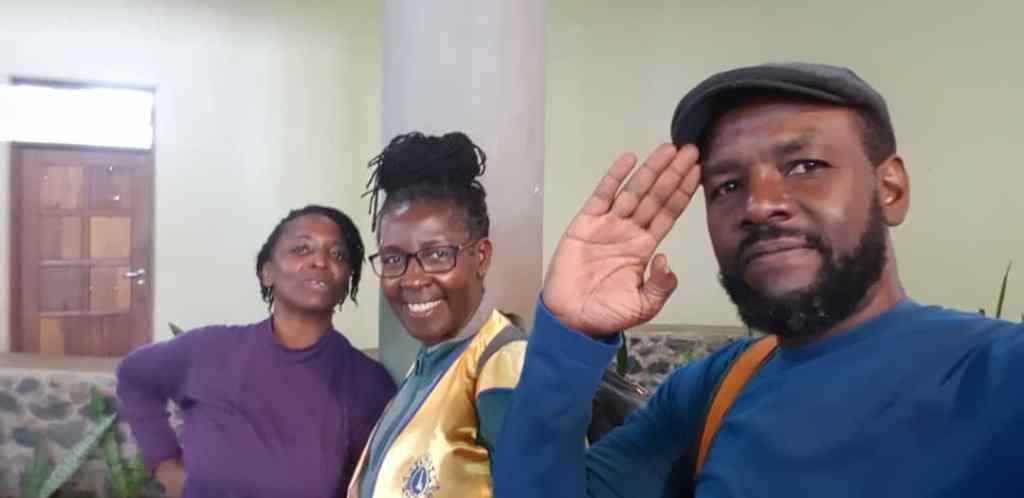
Lion Israel Manzi is very encouraging! He says mountain climbing has always been on his agenda. He prays his leg which was affected by a bodaboda accident heals fast enough for him to start climbing. He warms up to the Kili-Climb idea and wishes us well. Lion Emma Kansiime promises to join the next climb! Lion Omodo advises on developing an attractive concept to appeal to the public. We are all set!
After our proposal is accepted, we share widely a short write-up to request for contributions for the charity climb. We target to raise at least 200 life jackets for 200 children. We are encouraged by family, friends and the public, who pledge to support the cause. We set off for our journey on 1st March, 2020.
Guess what! We do not book any other plane but Uganda’s Bombardier! What a joy to travel by our own national carrier!
The climb starts on 2nd March. We take Marangu Route. The first stop-over on the Mountain is at Marangu gate where every climber is given pre-climb orientation which includes how to behave on the mountain, how to take care of oneself and others, how to listen to your body and not push yourself too hard, and how to take it slow. And why do I call this the first stop-over? Because we are already at 1,800 metres elevation on the mountain. The chief guide David Wachira of Last Mile Treks is already with his assistant guides; Jacob, Fred and Porters; Mohamed, Amsi and others. They are so professional. We immediately feel we are in safe hands.

By the time we leave the gate we are no longer just the three of us. We are joined by four Kenyans and one Switzerlander. Very empathetic people. Ask us their contacts! You might want to team up with them for your next climb!
There are many other climbers getting their orientation at Marangu gate. I am especially humbled by some of the climbers who are climbing to raise funds. Lee Wesley from the UK is with a team of climbers from South Africa. They are climbing to raise funds for an orphanage. Some of the climbers are miracle climbers because their health setup would otherwise not allow them climb. I immediately recognize how we take for granted the privilege of good health.
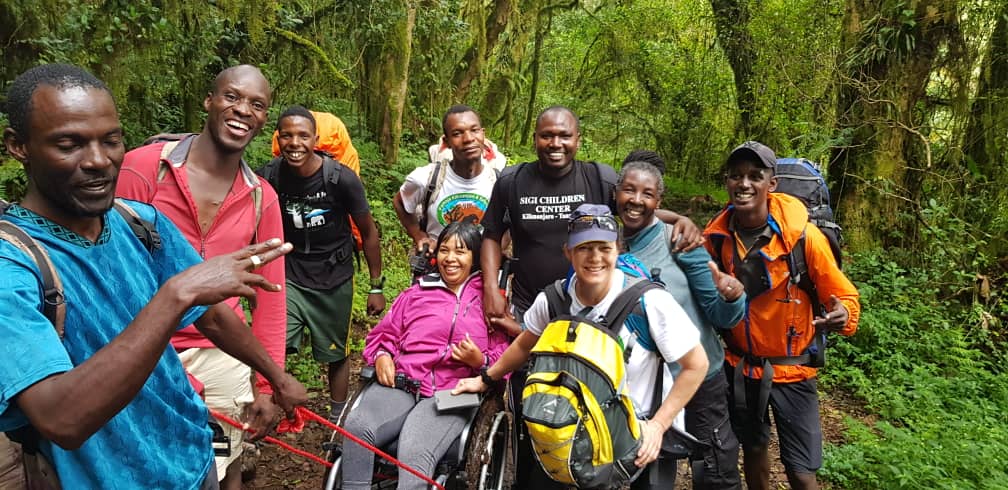
The actual trek begins at a gate that opens into the mountain. We sign the climbers’ book of consent and jump about to test our climbing boots and our mountain muscles.
We take a few pictures and wish each other good luck. Ann from Kenya says to us, now it is you and your legs. See you on the mountain. She saunters off. She has the energy of an antelope.
We are a bit worried as we set off. Clearly Ann is at another lever as a climber. But we are already in the no surrender zone. Fortunately, the gentle slope tricks us. It feels so soothing. We chat as we walk. We sweat as the mid-morning sun hits out backs. The mountain plants are a wunderkind sight!
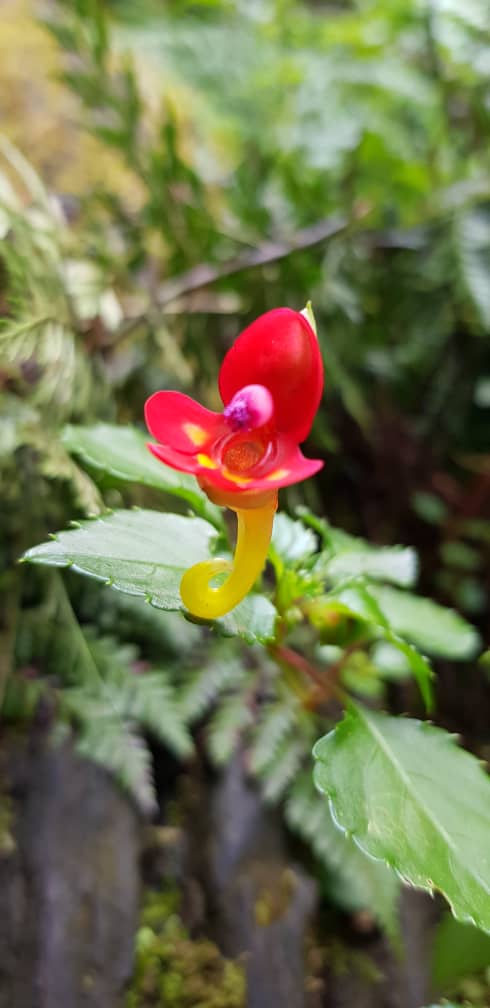
Giant trees stand at attention. Some have been here for hundreds of years. Small leafy trees take their space too. Little plants with flowers that literary light up the bushes are also present. For several kilometres the path moves along a whizzing stream. It feels like the stream is watching over the trekkers and keeping them company. When its sound starts to become distant, we start to worry; like we are losing one who has been a steadfast companion all along the journey.
We reach Mandara, the first camp on our route, at about 5.00 pm; a long first day. We are tired but we are excited. This is not our first trek though. A few years back we (Hilda, Pam, Sam), had climbed Mr. Muhabura in Western Uganda and Mt Elgon in Eastern Uganda. The Tororo Rock too in Tororo! In comparison, Mt Kirimanjaro is a friendlier slope so far. We do not want to remember the Killer Muhabura. We take our evening tea and chat away the evening as we wait for dinner. We are served at about 7.30. Everybody is scampering for hot soup! Thank God it is more than enough! The disappointment is that after it gets served by the time it reaches the lips it is no longer hot! The intense cold has already dealt with it. We go to sleep at about 9pm after instructions to be up by 7am so that we set off by 8. But do we sleep? The cold! It is that type of cold which sneaks to your every part of the body including the hair.
The second day starts on a very positive note. We remind each other about our cause for the climb; to save a life and put a smile on faces of a few children who will receive the life jackets. It is a pleasant day after all.
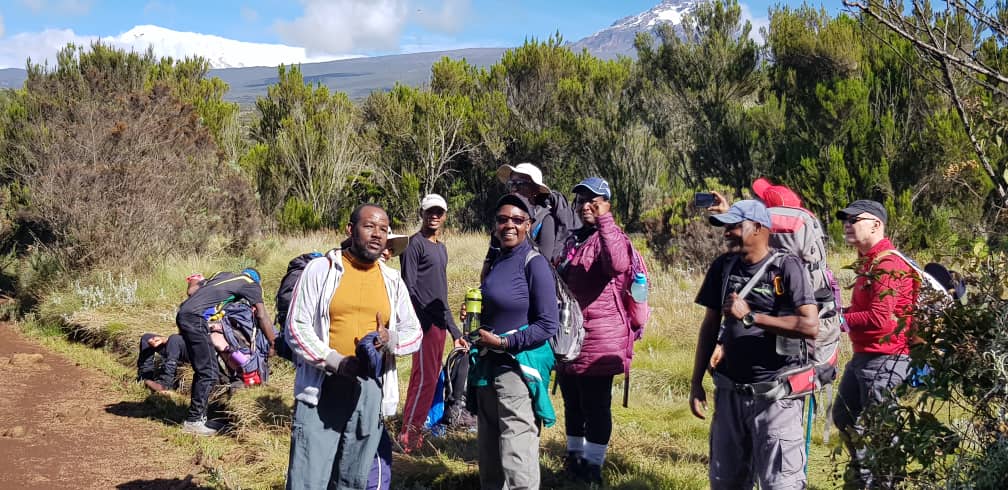
Some light rain and light sunshine accompany us. Jacob and Fred; the awesome assistant guides, explain to us that rain is good for mountain climbing because it helps to improve oxygen levels. As we go higher the terrain is changing too, to steeper slopes and shorter trees and shrubs. There is plenty of grasslands too, like a wide green carpet stretching on the slopes of the mountain. The mountain flowers are different too. The small red and pink ones downhill give way to small purple and white ones. By the time we seat and lie on smoothly curved rocks to eat lunch, we are almost finished. Our energy level is almost flat curve. But thank God, the lunch pack handed to us is some sort of recovery plan.
Very interestingly, along the way we reconnect with our whizzing stream and we are excited to find out that our next camp; Horombo, is positioned close to the stream. We do not see the stream but we hear it. When we eventually go to bed, it sings us to some sort of sleep, stealing itself in-between slabs of cold.
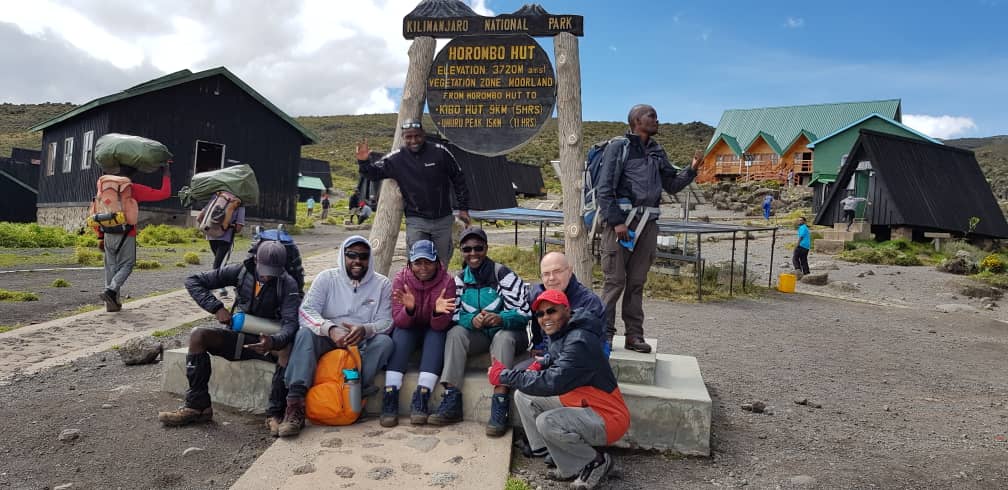
When we set off on the third day, we remind each other about our mantra for the journey; Things always fall into place – if we let them. The mountain is becoming steeper and colder. The vegetation is getting scanty. We are getting tired. But we are a strong team.
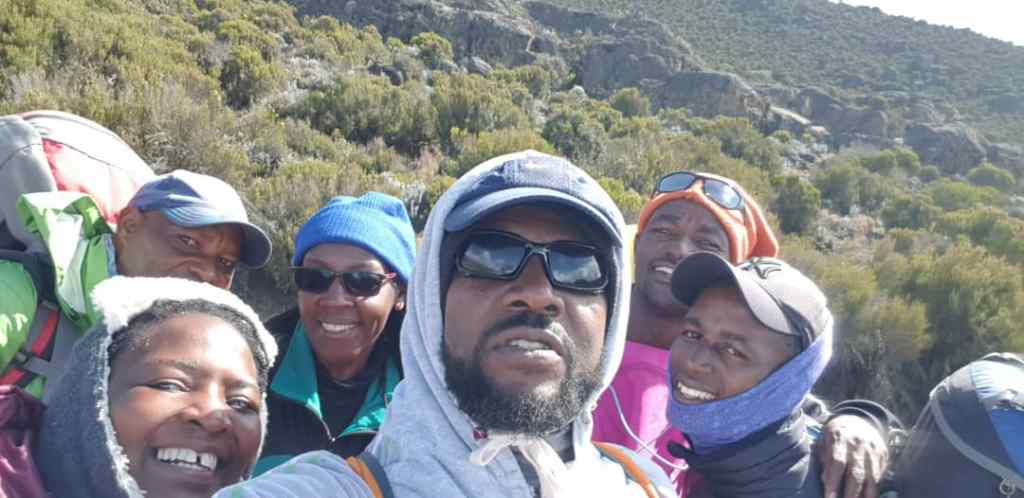
We head away from our great companion; the mountain stream. It is an extremely long day. When we stop to eat our lunch; a few biscuits, a piece of chicken, an egg, a banana and a small juice, we just want to remain seated. But we must move on. Sam is on a chicken fast so Pam and I share his piece. I give him dry fruits in return; pineapple. Jacob laughs and tells us we must eat a lot of food but he does not explain why. We need the food man! We are not just hungry. We need the energy!
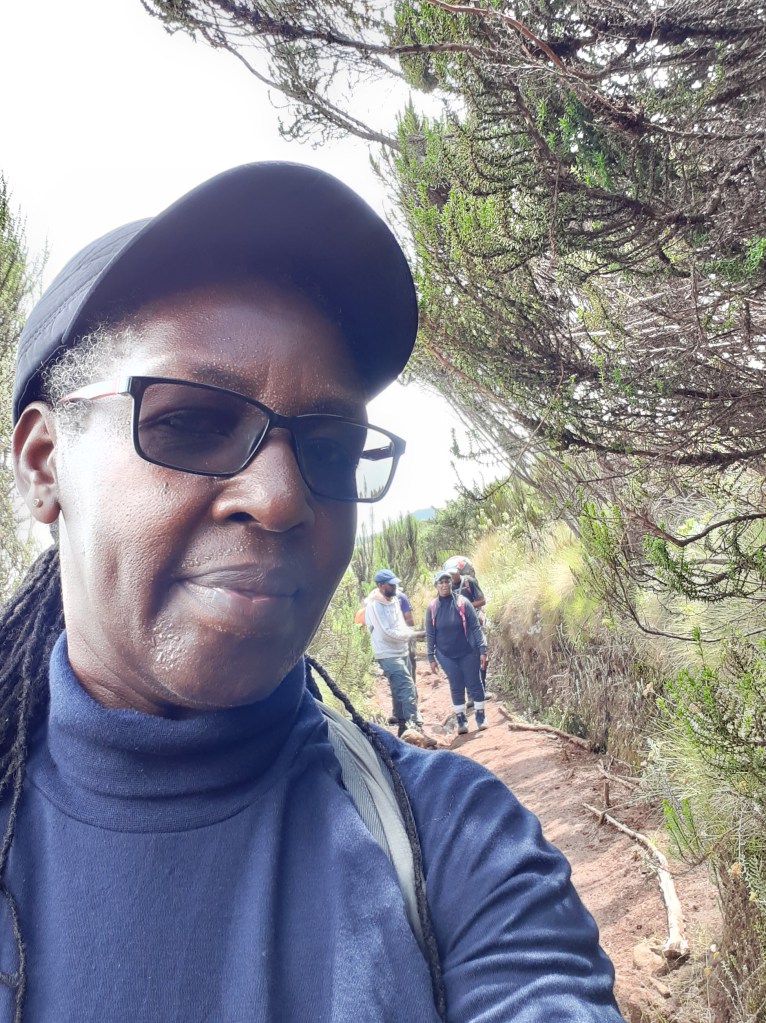
As we approach the 3rd camp it looks like it is set right under rocks and white glaciers. But as we get closer, the camp looks more spacious and not so under the rocks. The glaciers slither through the rocks away from the multi-coloured camp huts. The signpost welcomes us. Kibo Camp.
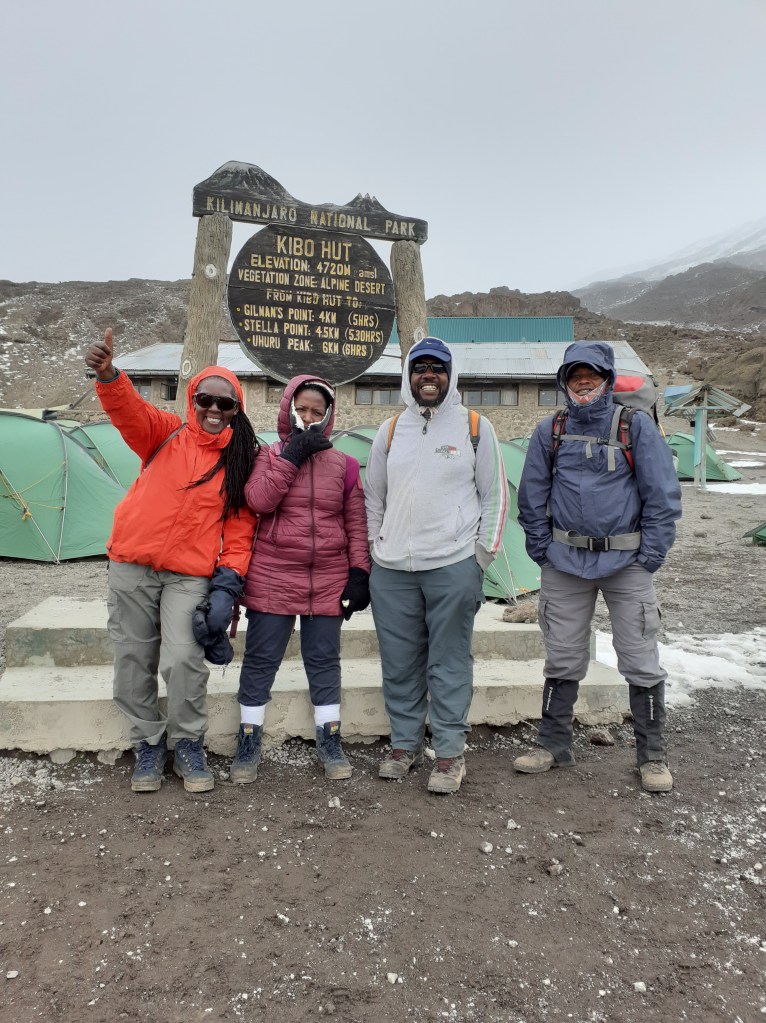
Kibo is very interesting. It is like a proper homestead. A few huts close to each other, a few tents for those who do not want to use huts, people cooking, and people talking. And who says East Africa does not know snow? In the early evening as we prepare to go to bed, a few snowflakes begin to do their dance in the air exciting some of us. By now mountain climbers are quite many. Maybe we are about 30 people at Kibo Camp. Later, more snow comes dampening our spirits. We all quietly pray that it does not go on. We watch it gather and build in front of our hut doors. We refuse to imagine coming all the way only to end at Kibo due to snow!
By now David has convinced us we are strong enough to make it to the top of Mount Kilimanjaro – The roof of Africa – and back to Marangu gate in five days and he has shared the plan with us. We are hesitant. The plan involves sleeping half way through the third night so that we wake up in the night and start the final climb at midnight as the fourth day is just starting so that we summit at Sunrise and return to Kibo by mid-morning.
We are trapped! Sunrise on top of Kirimanjaro would be the most amazing experience any climber could hope for! David adds that that plan would allow us to get back to Kibo during the day after summiting, rest a bit and set off late afternoon back to Horombo. We would then sleep at Horombo on our way down. Five Days!
We are all excited and we swallow David’s bait. We eat our dinner quite early between 5 and 6pm. We are advised to eat little because oxygen is dwindling and therefore not enough for breathing and doing the heavy job of processing too much unnecessary food. We now understand Fred’s laughter. Kibo is at 4,720 Metres elevation above sea level.
In the end we do not really sleep half the night because we are up by 10pm. Some of us have not even slept at all. If the cold at Mandara and Horomo could fill buckets, the cold at Kibo sticks to the body like a tick. It cannot be shaken off whatsoever!
We eat our “breakfast” in silence. David checks our clothes, our raincoats, our water bottles, our neck scarves, gloves, and windbreakers. Some of us do not have some of the essential things. Those who have anything they can spare pass it over to the person in need. Jackets, gloves, scarves, thermos-vests and huts, exchange hands. Things indeed fall into place! I also benefit from the exchange. Ann, remember Ann from Kenya, passes a nice little pink jacket. I hug it to my body like I have never owned any jacket before. David from Kenya passes green gloves. I slip them on immediately over my other pair. I pull out a raincoat too and pass it over to Pam because hers is too light.
We are all praying that we make it. The snow which has gathered on our doorstep as we set off is scary. But we move nevertheless. We have an agenda. We need to accomplish our race, raise funds to buy Jackets for school-going children.
Walking in the middle of night, through rocks, through knee-deep snow, though chunks of cold being hurled into your face turns out more adventurous than we had signed up for! It is clear we are being accosted by a blizzard and it intensifies with every step. We walk on. Fortunately or unfortunately for us our Chief Guide, David, gets caught up. One of his clients gets a problem and he stays behind to help. We are on our own with three of his most trusted assistant guides. We meet some people returning and they tell us we cannot summit. Why, we ask. They tell us the summit area is almost cut off by the blizzard. We listen but we continue. One laboured step after the other. One laboured step after the other. We think we should go back. It is becoming really dangerous. But the thrill is too tempting too. We can already see the rock above which is the end of the climb!
We stop briefly to agree to return. Instead we agree to move on. It should not take too long. We are almost in tears! And then, one by one we climb over the rocks and we are in the summit area! We are so excited to see the signpost! Congratulations! You are at Gilmans point. We have summited! We take a few snaps and the phones freeze!

We must take a picture in the Lions Jacket! One of us screams. But none of the phones can turn on now. They are frozen. We had hidden them deep into our pockets wrapped in layers of things to keep them warm. But have already exposed them enough with the few pictures we have taken. As we bargain on what to do, stronger than any wind we have ever witnessed hurls us against rocks and against each other. We can hardly look up! Bellow the other side of the climb is an escarpment. In the circumstances, we feel like we are at the edge and the wind could easily blow us downhill. We must return now! Jacob says. This time we do not question him.
That we write this story is testimony that we returned safely. And had we taken a few more days enjoying Arusha, COVID-19 Lockdown would have found us out there.
Whereas over one hundred people had pledged to support, COVID happened and the story took a totally different turn. For most of our economies, where most of us are never sure of our next meal, COVID became a monster. But we thank God for a safe journey and for every coin that was raised.
A big Thank you to Team – Things will fall into place, if you let them! A bigger thank you to all who contributed to the climb as listed below! I am all GRATITUDE on behalf of my home area, Lake Bunyonyi region!Together we brought a smile to the faces of the children.
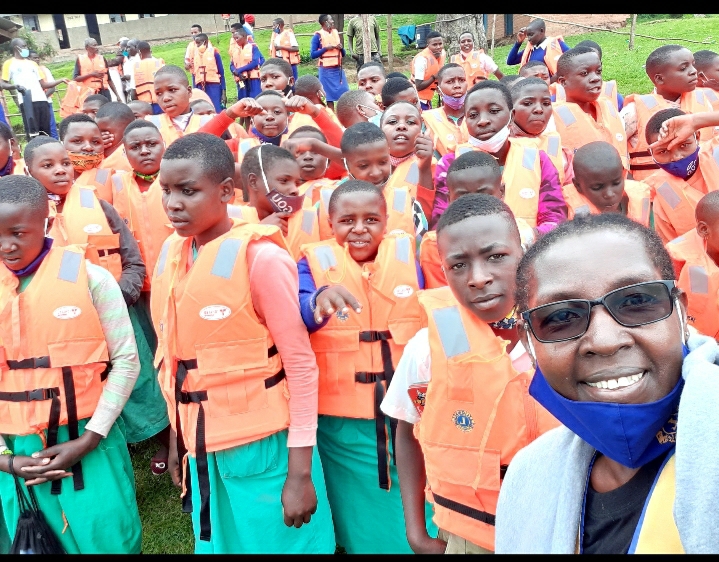
Kilimanjaro Climb for Life Jackets
- Hilda Twongyeirwe and Family 300,000
- Pamela Batenga 120,000
- Samuel Iga Zinunula & Patricia Nyachwo Zinunula 270,000
- Stella Nanziri 320,000
- Sarah Mukasa 200,000
- Bwesigye Bwa Mwesigire 260,000
- Chris Conte 300,000
- Brian Nadhomi 50,000
- Kimberly Poole (International Sheroes Union) 120,000
- Mary Mahoro 120,000
- Warda Katende 60,000
- Mary Jo Kakinda 65,000
- Oscar Ranzo 50,000
- Kakuru Karemeera 325,000
- Doreen Straus and Family 490,000
- Ahimbisibwe Joab Kahangura 50,000
- Edna Kahangura Natweta 50,000
- Frank Kwarikunda 50,000
Total Amount Raised on the mountain 3,210,000
Keep your ear to the ground and join The Overwhemers for the next climb for a cause!
For Health & Resourcefulness

 Twongye'wanderings