https://x.com/twongye/status/1984642592588415409?t=iSIWA0ebcVm5u2fi2FKtDg&s=09
Category: Uncategorized
Please support FEMRITE build a home!
I owe it to you all, dear friends, for the Kilimanjaro climb Fundraiser for FEMRITE Writing & Wellness Centre.
FEMRITE helps women write & have a safe space, but it’s also home to writers in Uganda and beyond.
We continue to call upon your generous financial support to enable us to build a home.
MM: +256772743943
ABSA Bank Acct: 0341210186
Every Coin Counts
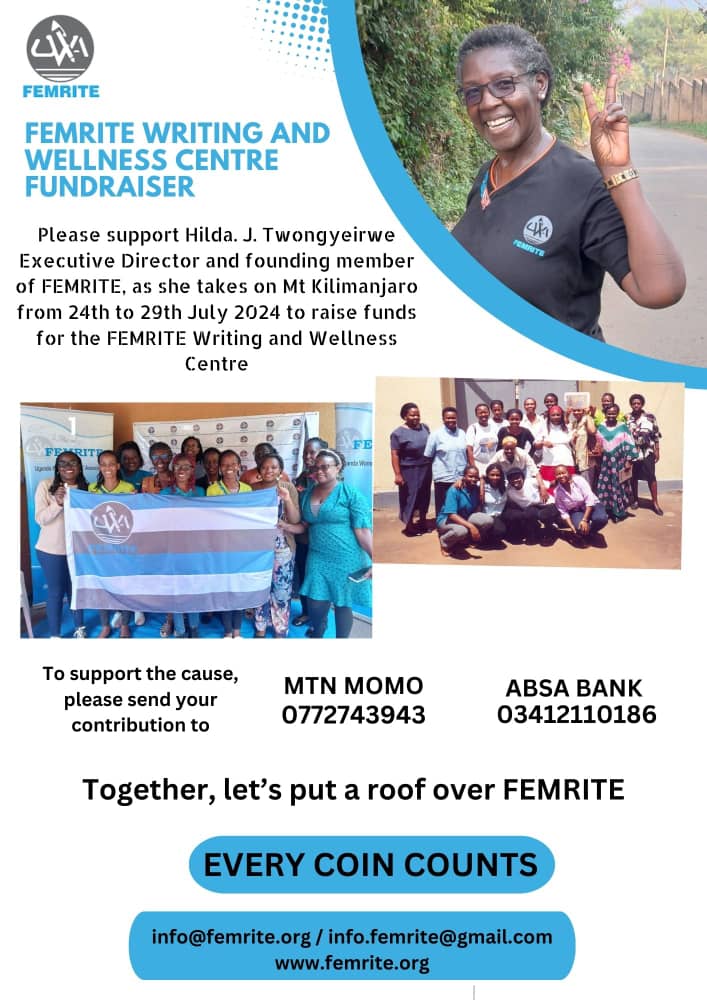
Hiking for a Cause: Support FEMRITE Writing and Wellness Centre
Dear Friends of FEMRITE,
It is a great honour this 2024, to be part of the FEMRITE Team, launching our plan of putting a roof over FEMRITE, to build a Writing and Wellness Centre.
It is a dream that has come a long way, a dream that FEMRITE needs to now actualise, with your support. In the past, we talked about the centre but kept tucking away the dream because we looked only at the small family of FEMRITE. The dream felt unimaginable for a non-profit organisation whose every coin goes into the implementation of programmes of strengthening writing and reading in Uganda and beyond.
Today, I join the FEMRITE sisterhood to lay bare our dream because we recognise the power of community giving. I invite all our well-wishers to support the climb by making a contribution towards the writing and wellness centre.
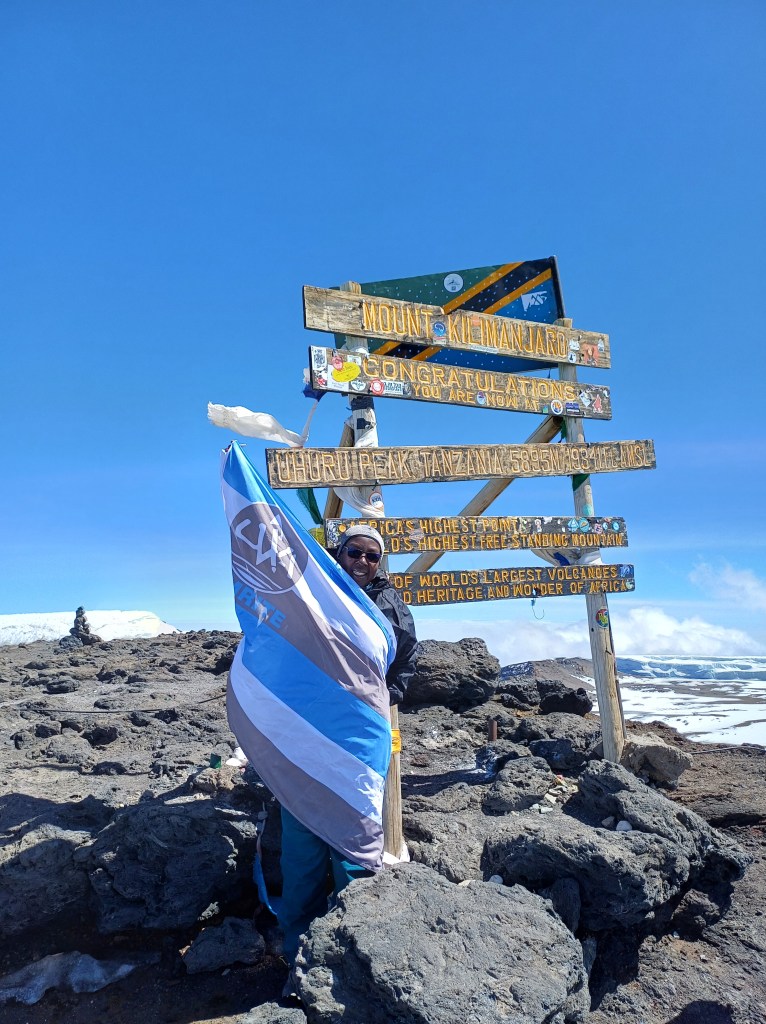
Today, I embark on a six-day fundraising journey, a hike of Mount Kilimanjaro from 24th to 29th July 2024. Praying for good health and good weather. As one of the founding members of the organisation, it has been a joy watching the organisation grow from baby steps to adulthood.
On a personal note, I want to recognise friends and supporters who have been very instrumental in encouraging us on this plan. I recognise the main funder of the organisation, Hon. Mary Karooro Okurut. Probably when she was gathering the first women in 1994, she did not realise that the organisation would still be here 30 years later and still relevant.
Our slogan for this fundraiser is that Every Coin Counts. We earn differently, we have different financial obligations and so we can not all give the same. But when we all give, it makes such a big difference.
Today, we embrace the power of community giving and call upon our supporters, our partners, our friends, friends of our friends, to support the cause of building this writing legacy for the country, for the continent, for the world. FEMRITE has an open-door policy that has enabled the organisation to build bridges across countries and across continents. It is our prayer that together, we gather each brick and build the Writing and Wellness centre.
Actualising the centre beyong rented premises will be to strengthen the sustainability base of the organisation, to give it a life beyond the current membership and leadership, so that even the children of our children can find it and do their duty in maintaining it and transforming it to match their times.
There are many challenges we face as older people, as younger, as people. The need for reflection and wellness spaces has never been more crucial than now.
FEEMRITE space is not just a concept. We have witnessed its power. It is a space where we have had cups of coffee and tea together, a space where we have hugged and cried on each other’s shoulders, a space where we have birthed stories and supported one another, a space of truth and reflection.
To support the cause, please send your contributions to +256 772 743943 or Bank Account: 03412110186
THANK YOU
Together, let’s put a roof over FEMRITE
Every coin counts.
info@femrite.org / info.femrite@gmail.com
Austin Bukenya @80
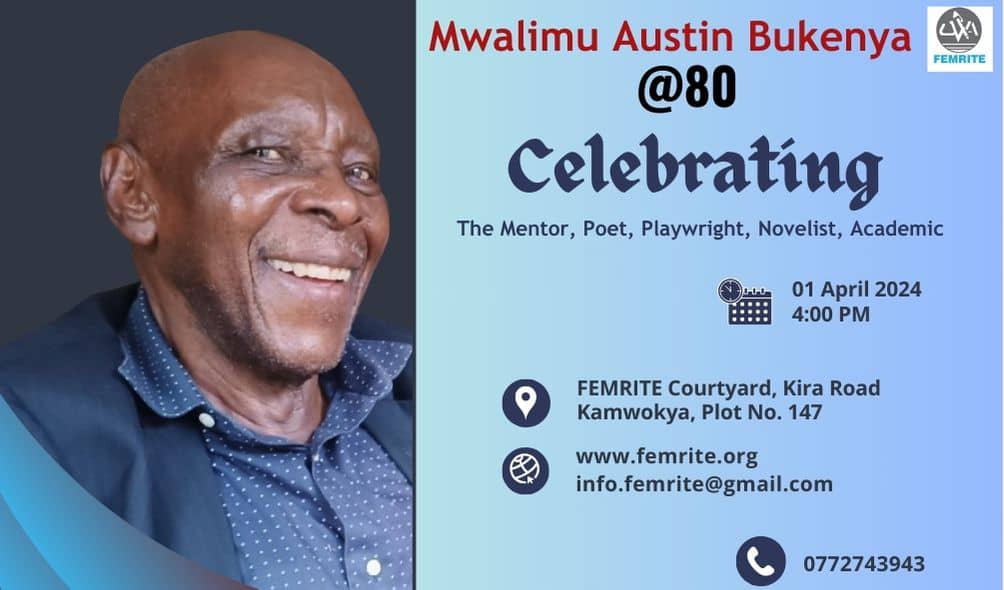
FEMRITE-Uganda Women Writers Association, is set to host Mwalimu Austin Bukenya in celebration of his 80th birthday.
Mwalimu Bukenya is one of the founding members of the organisation. He offered his space, which he shared with Mary Karooro Okurut in the early 90 at Makerere University, to allow women sit and discuss the beginnings of the organisation. As such, Mwalimu is one of the 5 honorary members of the organisation. According to Hon. Okurut, Honorary Membership is the highest honour bestowed on members of the public who show unrivalled solidarity to the organisation. “This is a position that makes him one of the most special people to the FEMRITE sisterhood,” Karooro said.
Other FEMRITE Honorary members are; Dr Monica Chibita, Dr Thomas Ogwang, Ms Addy Beukema and Prof Maggie Gee.
Mwalimu Bukenya is a key figure in East Africa’s literary spaces. He is a poet, a novelist, a short story writer, a playwright, a literary critic, a newspaper columnist, a mentor, and much more.
The Mwalimu @80 celebration will be held on April 1st, 2024, at the FEMRITE Courtyard.
For fans of Mwalimu, and for those who might not have interacted with his work, this is the time. There will be poetry recitals and readings from his works.
The event will start at 4pm and end at 7pm.
International literature conference 22nd to 24th Nov 2023
In Honour of Nobel Prize Laureate – Abdulrazak Gurnah
Conference Announcement Reissued as dates draw closer…

The International Literature Conference in honour of the Life & Works of Nobel Prize Laureate – Abdurazak Gurnah, will be held from 22nd to 24th Nov 2023, at Makerere University, Kampala.
It is organised by FEMRITE – Uganda Women Writers Association, The Pan-African Writers Association, Makerere University with support of development partners.
Theme of the conference remains Celebrating the Life and Works of Abdulrazak Gurnah for the future of African Literature. Subthemes include:
1. Abdulrazak Gurnah’s Life In perspective
2. The Works of Abdulrazak Gurnah
3. Migration and African Literature
4. Literature in African Languages
5. African Literature and Publishing
6. The Nobel Prize and African Literature
7. Literature and Modern Technology
8. Literature and Cultural Technology
9. Indigenous Languages in African Literature
10. The Role of Translation in African Literature
11. Literature and Climate Change
12. Literature, Peace Building and Security
13. Love, Romance and Betrayal in Abdulrazak works
14. African Literature And Artificial Intelligence
15. Decolonisation in African Literatures
16. Identity and the Diaspora in African Literatures.
17. African Oral Literature (Orature) and Decoloniality
Each Paper shall have a title, an abstract; of not more than 250 words, name (s) of the author(s) and their address(es) including phone numbers and email addresses. The Paper should also be in Microsoft Word, typed in Times New Roman, 12 font size, double-line spacing, a maximum of 3,000 words. For referencing please use the APA Reference Style, 7th edition.
Send your papers to info@femrite.org & copy; pawahouse@gmail.com, kiizatisaac@gmail.com & twongye@gmail.com.
Deadline for submission of full papers is 25th September 2023.
Please include your abstract on the first page of your paper.
Thank you all who already submitted their papers under the first Call.
▲NB: DO NOT RESEND IN CASE YOU ALREADY SUBMITTED UNLESS YOU HAVE MADE SOME CHANGES
▲ REGISTRATION FEES; Ugandan – 100,000UGx, Non-Ugandans – 50USd, Ugandan Exhibitors – 100,000, Non-Ugandan Exhibitors – Exempt
Registration closes on 30th October 2023. We look forward to hosting you.
GMT Uganda Networks Ready to Build a Community of Practice
Guest Writer
Stella Atwongyeirwe
Posted 28/07/2023
“We can work together as groups or choose to work together as communities, either way there are repercussions,” Harriet Tugume, Danie Consult.
Today the 28th of July 2023, Graca Machel Uganda Networks held a debrief workshop to close off activities of the first part of the Women Leadership and Financial Inclusion project, dubbed Pathway1 and to usher in the second part dubbed Pathway2. This was at Hotel Africana in Kampala.
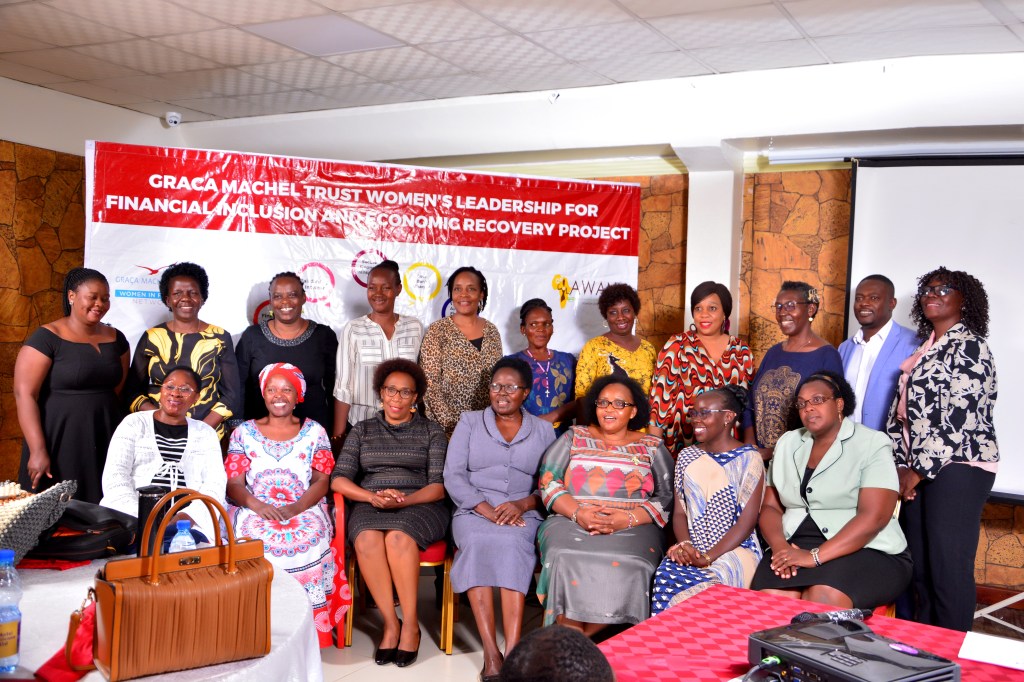
Pathwas two is a continuation of the Women Leadership and Financial Inclusion project which started in 2022.
Its main objectives include:
• To advocate for gender inclusive COVID-19 economic recovery strategies that put women at the centre of the economic response and promotes accountability for policy action.
• To build a critical mass of African women leaders in key economic sectors, who have the confidence and skills to exercise their agency and representation to advance women’s financial inclusion.
• To enhance the participation of women in financial regulatory policy making through strengthening women’s Networks that elevate the collective voices of African women to improve women’s financial inclusion.
Harriet Tugume one of the resource persons commended GMT networks for coming together and said that they must work towards building a community rather than just being a group of women. “To become a community you must have common objectives, you must work together, you must have shared values and you must do things together,” she said. “When one says you are part of his community, it is different from when he says you live in their neighbourhood,” she emphasised.
Women who participated in the workshop underscored the need for all government sectors to consider gender equity in the distribution of roles in services delivery taskforces. Key among the taskforces mentioned were the covid 19 taskforces at all levels, from National to village level. They continued to demand for at least 40% women’s representation on Covid 19 task forces. Hope Kasimbabazi, of Private sector Foundation reminded participants, that although the focus was covid 19, all sectors need to be pushed because lobbying in piecemeal is not very effective sometimes.
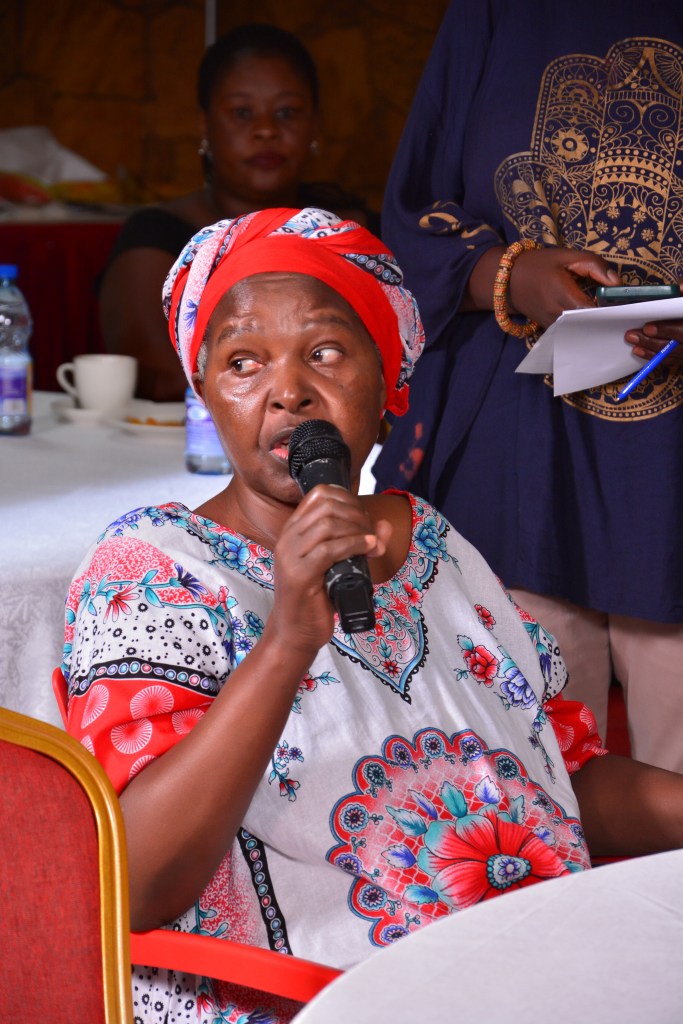
“Now that we have pathway2, lets use it to lobby for at least 40% in all sectors. Today it is covid19, tomorrow it will be Ebola, the next day it will be something else. We need to build a lobbying approach that will put women in sectors equitably” Hope ephasised. Hope is an entrepreneur with
In order for GMT networks to scale up advocacy work, Pathway 2 is mainly dedicated to building communities that will work together to achieve desired goals. Among the activities the networks are tasked to identify champions to work with. These should be people of high integrity in society and they should be willing to be part of the process. Christine Muyama, the Advocacy Officer at GMT, pledged support on behalf of GMT and said that they would support advocacy activities especially those driven by Champions.
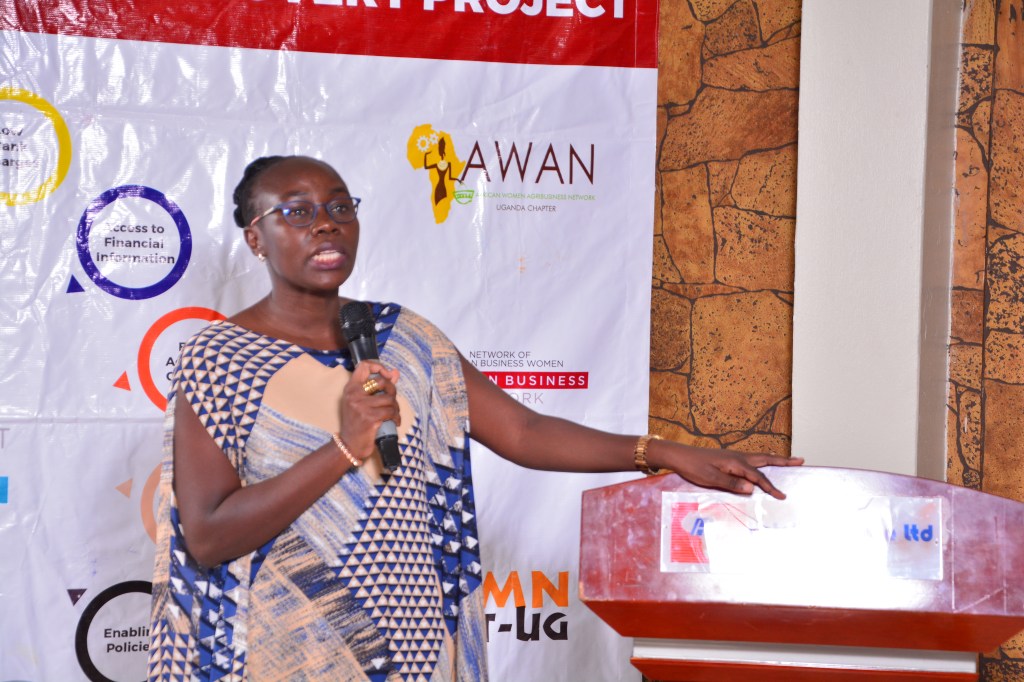
“In building supportive community we shall need champions to drive the agenda. We cannot pay the champions but we can facilitate them to do advocacy work,” she said.
Women in Uganda demand equitable representation in Public Procurement Tenders
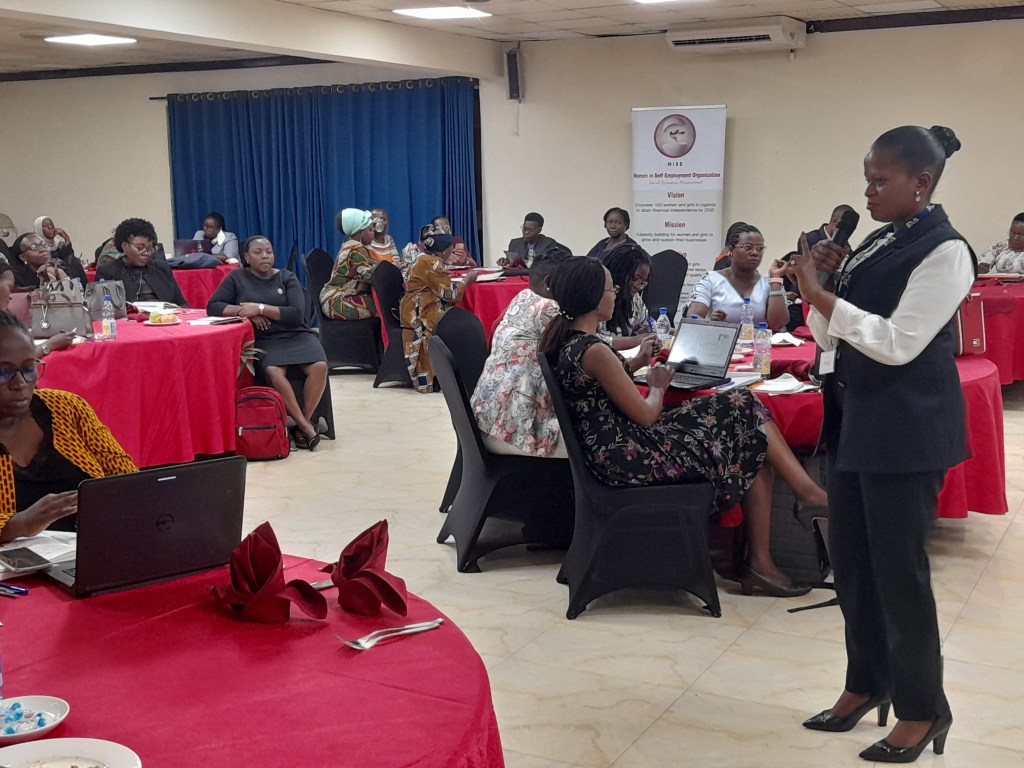
Ugandan Women Engage with Public Procurement & Disposal of Assets Authority (PPDA) staff
It is argued that Public procurement accounts for a significant share of governments’ annual expenditures and thus one of the major sources of revenue for those who get the procurement tenders.
In Uganda, women in business have demanded a fair share of Public Procurement tenders. This was fronted at a stakeholder dialogue organised by the Graca Machel Trust Networks – Uganda, held at Hotel Africana in Kampala on 18th January 2023. Connie Kekihembo, the Executive Director of Uganda Women Entrepreneurs Association Limited (UWEAL) and the lead researcher on procurement policies in Uganda quotes Harvard University, 2012, that, “While data vary, it has been estimated that public procurement constitutes 10-15% of GDP in developed countries and up to 20% in developing countries.
The Director of Capacity Building at the Public Procurement and Disposal of Assets Authority, Moses Ojambo, presided over the event, which was aimed at lobbying, and advocating for gender responsive procurement policies. “We need policies that will provide opportunities for women in MSMEs and enable them to effectively participate in government public procurement processes,” the women argued. The activity was part of a bigger Women’s Leadership for Financial Inclusion and Economic Recovery project that is being implemented by GMT networks in different countries in Africa. Uganda is one of the countries implementing the project.
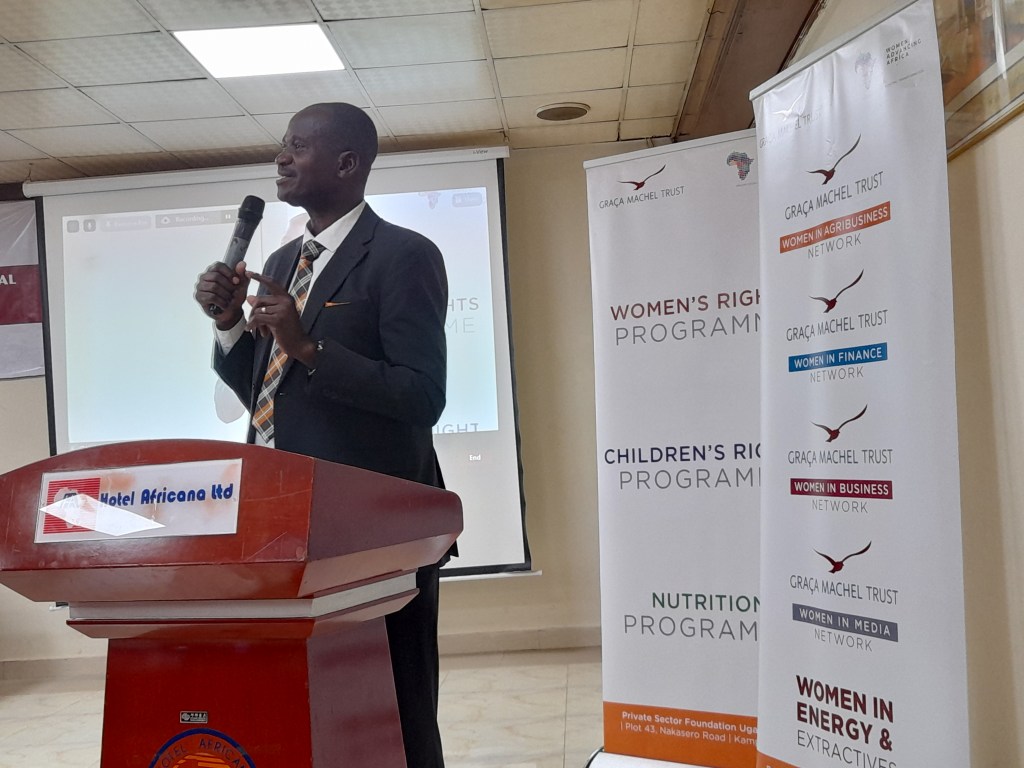
Ojambo explained that although the 2020 Amendment ACT gives marginalised groups such as women and people living with disabilities, 30 percent representation in access to procurement deals, there is need for the Ministry of Finance and Economic Development to develop and share guidelines for effective implementation. Ojambo revealed that the ministry was already in the process of developing the said guidelines and that once ready, they would contribute greatly to ensuring gender equity in the procurement industry. “Initiatives such as the Graca Machel Trust Convening which take interest in PPDA activities and which create a platform for conversation around such issues, are crucial in reminding government and holding it accountable for inclusion,” he said. Irene Nafunjo, Senior Compliance Officer at Equal Opportunities Commission concurred with her and said that, “We have a duty and a right as citizens to get involved and advise government during law reform processes before the proposed laws get signed into law. Nafunjo was part of the panelists at the event.
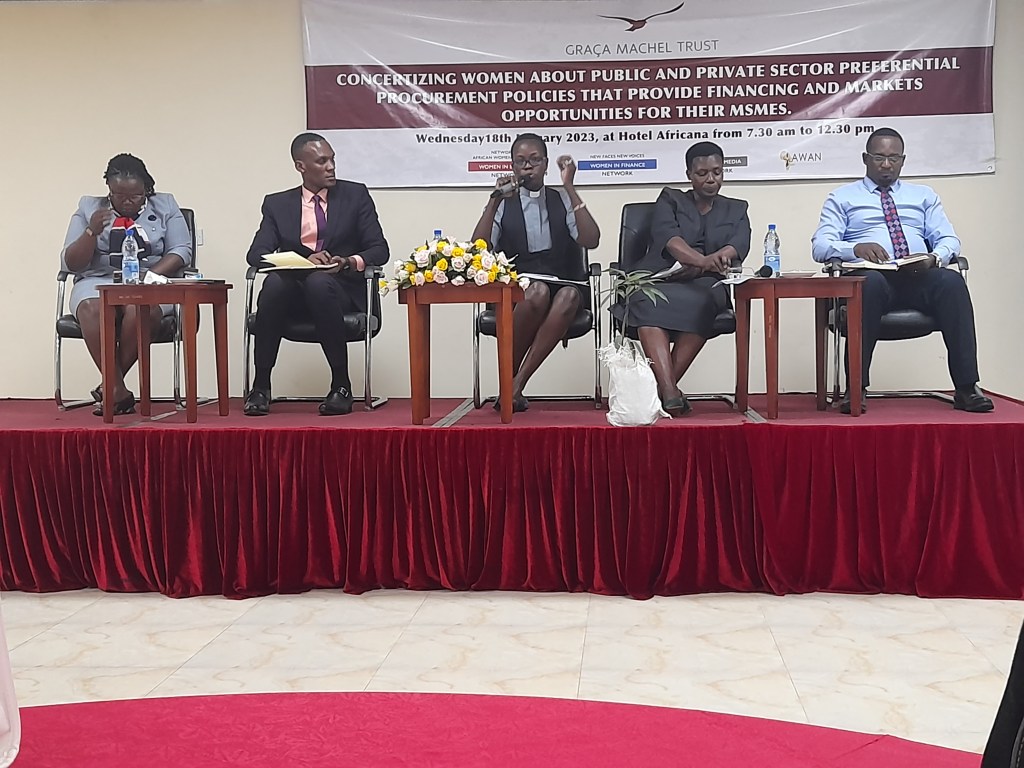
Others on the panel were Abel Mwesigye – the Executive Director of Kampala City Traders Association (KACITA), Rev. Gillian Amongin – Representing Ministry of Finance and Economic Planning, Mayie Banyenzaki – Representing Ministry of Local Government and Innocent Tushabe – representing Min. of Gender Labour and Social Development.
In her opening remarks , Shiphrah Chinsha, Shiphrah Chinsa, Director of Programmes at the Graca Machel Trust, challenged women to be more organized, form strategic partnerships, be alert and position themselves for opportunities in the business of procurement. She noted that although the barriers are numerous, women must learn to maneuver their way out. She said, “You must not just think outside the box but throw away the box and build new knowledge and new markets.” She said that despite government’s proposals, women in procurement in Africa remain at only 10%. She challenged women to start thinking different in order to meet the demands of Uganda today.
Several business sectors were represented at the event; women in coffee growing and processing, food processing, landscapers, Carpentry, accountants, public health, tours and travel, and many others. They interacted with a panel of experts drawn from different institutions; Innocent Tushabe – Min of Gender Labour and Social Development, Mayie Banyenzaki – Min of Local Government, Rev. Gillian Amongin – Min of Finance and Economic Development, Abel Mwesigye – Executive Director Kampala City Traders Association and Irene Nafungo – Compliance officer at Equal Opportunities Commission.
Beatrice Lugalambi, the General Manager, Business Development and Marketing represented Centenary Bank at the dialogue. She pledged, on behalf of the bank, to support women to engage in government programmes. “As an institution we have a lot of services to offer women; we can offer advisory services or even training in public procurement issues,” she said.
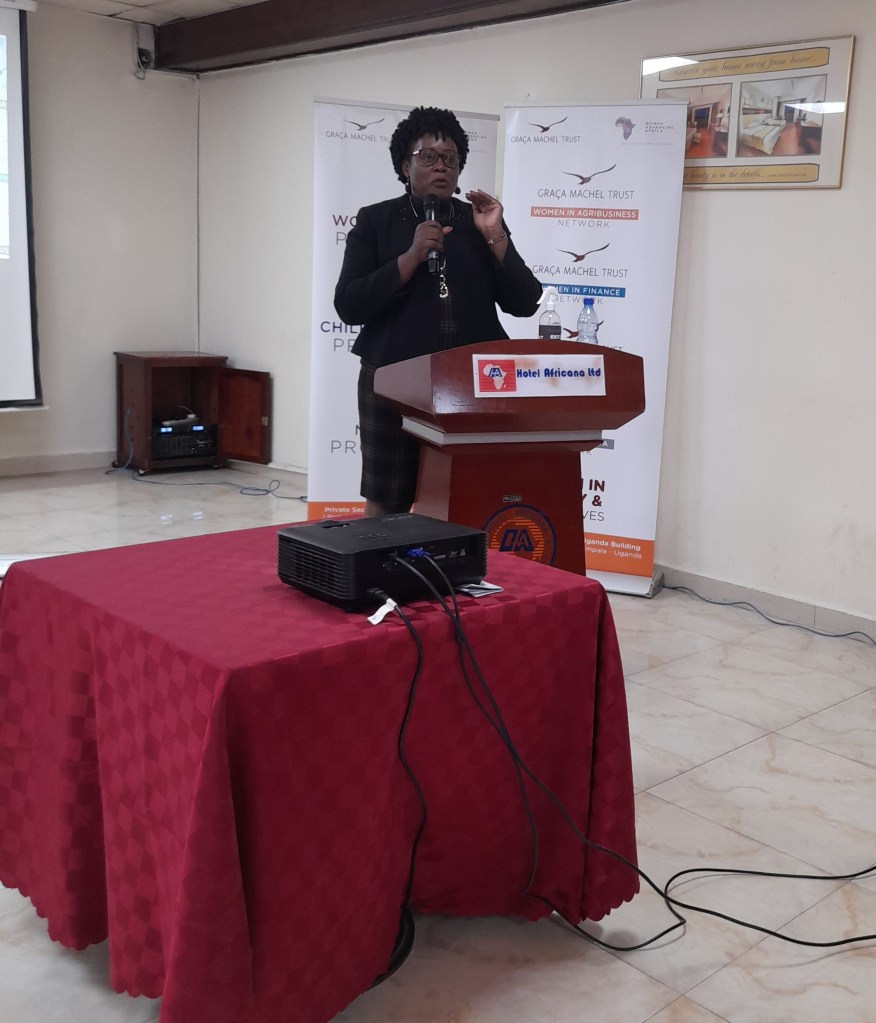
Warda Katende of New Faces New Voices revealed that, in addition to the existing challenges, there is lack of clear segregated data to enable functional monitoring and evaluation of procurement services. She advised that the new guidelines being developed by MF&EP should take into account the need for gender disaggregated data in government processes and other relevant institutions. “Government and other relevant institutions must be intentional in data collection in order to have backing for creation of relevant policies,” she said.
Florence Kasule, the Chairperson of GMT Networks – Uganda, also attended the dialogue. She questioned the 2020 PPDA ACT and said it would remain meaningless as long as women continued to be left out of the Public Procurement processes; “We want o be wealth. We do not want to remain trapped in small businesses. We want to grow. We want to be fully represented in the procurement Industry.” she said.
The event was attended by women from several business sectors. The Executive Director of Uganda Women Entrepreneurs Association Ltd (UWEAL), Ms. Constance Kekihembo, was the lead researcher in preparation for the event. She asserted that women have the capacity to absorb procurement funds and to run businesses very professionally. In her Position Paper presented at the event and titled; Unlocking the Potential of Women to Participate in Public Procurement, Ms. Kekihembo quoted Kirkton, 2013 who wrote that, each year, despite USD15 trillion passing through government hands to suppliers through the government procurement market, only 1% goes to women-based organisations. She called for bold steps to be taken to close the access to financial services gap between men and women, including bank accounts, saving, housing finance, SME loans, equity, insurance products and digital payments. Ms. Kekihembo called for a transparent procurement System that is guided by clear gender responsive policies.
As icing on an already delicious cake, Cecilia Nakitto, a member of GMT Uganda networks and a successful business woman shared her successful story of how she entered the procurement business. “It might be difficult to enter but it is very lucrative business when you get in. The major requirement is to have your house in order and to be confident,” she said.
The event was a hybrid – both physically at the Imperial Royale Hotel in Kampala, Uganda and online via Zoom.
Links for articles on the event
- https://ugandaradionetwork.net/story/women-facing-challenges-winning-govt-contracts-
- https://youtu.be/FgjC27mGIko UBC LUNCH TIME NEWS With Rhoda Ngonzi 19th January 2023.
- www.monitor.co.ug – Daily Monitor: What is holding women back from tenders? By Joan Salmon, 21/01/2023
Mount Kilimanjaro Climb for Life Jackets, for School Children in the Lake Bunyonyi Region.
Please note that this article is republished from the Lions Magazine 2020.
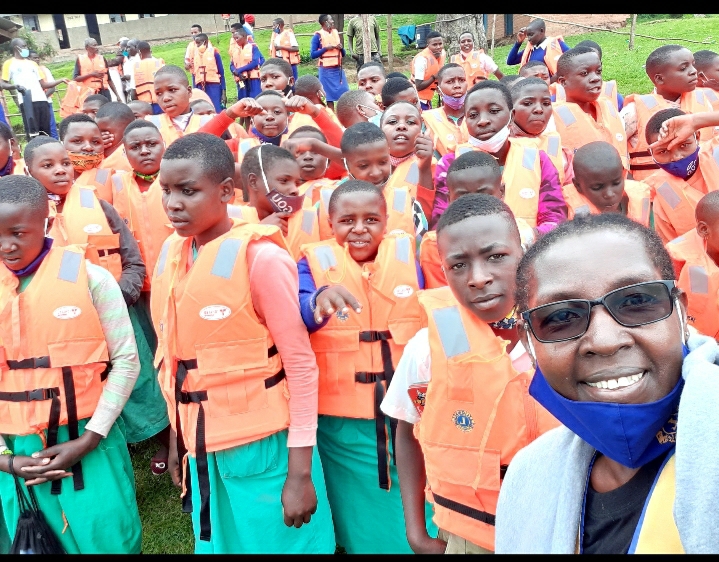
The majority of children who cross the Lake Bunyonyi on a daily, going to school do not have life jackets, yet most of them cross in small canoes being attended to by fellow pupils barely 13 years of age.
Forget the fact that they are aware that Lake Bunyonyi is the second deepest Lake in Africa at 900metres deep. They study that fact in social studies. It is next to Lake Tanganyika which is the first in Africa at 1,470 metres. Lake Tanganyika is the second deepest lake in the world; The deepest being Lake Baikal in Southern Russia at about 1,642 metres deep.
But what does a child do in the face of limited options? Jump on the canoe, in search of a better future. Having grown up in Kacerere village close to the shores of Lake Bunyonyi, I totally understand their plight.
It is 11th January, 2020 about 6:55pm. Lion Hilda Twongyeirwe, Mr Iga Zinunula and Ms. Pamela Batenga, representing The Overwhelmers – a mountain climbing group, submit a proposal to the Kampala Central Lions family, to join in the fundraising effort for life jackets for children in the Lake Bunyonyi Region. The proposal is to Climb Mount Kilimanjaro and ask the public to support the climb by contributing to the drive. The Club approves the proposal and gives the team a go-ahead. The President, Lion Frank Muramura, offers the group a bright yellow Lions jacket for identity (clap clap).
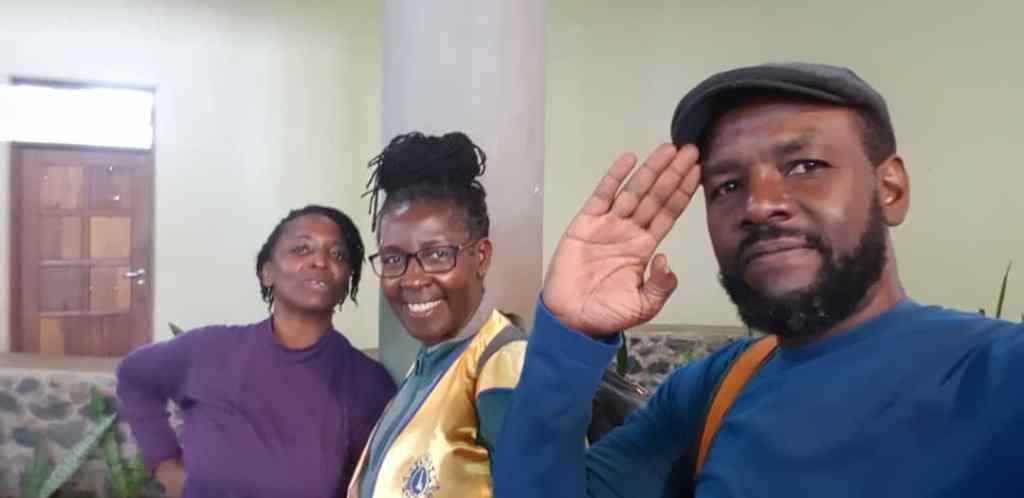
Lion Israel Manzi is very encouraging! He says mountain climbing has always been on his agenda. He prays his leg which was affected by a bodaboda accident heals fast enough for him to start climbing. He warms up to the Kili-Climb idea and wishes us well. Lion Emma Kansiime promises to join the next climb! Lion Omodo advises on developing an attractive concept to appeal to the public. We are all set!
After our proposal is accepted, we share widely a short write-up to request for contributions for the charity climb. We target to raise at least 200 life jackets for 200 children. We are encouraged by family, friends and the public, who pledge to support the cause. We set off for our journey on 1st March, 2020.
Guess what! We do not book any other plane but Uganda’s Bombardier! What a joy to travel by our own national carrier!
The climb starts on 2nd March. We take Marangu Route. The first stop-over on the Mountain is at Marangu gate where every climber is given pre-climb orientation which includes how to behave on the mountain, how to take care of oneself and others, how to listen to your body and not push yourself too hard, and how to take it slow. And why do I call this the first stop-over? Because we are already at 1,800 metres elevation on the mountain. The chief guide David Wachira of Last Mile Treks is already with his assistant guides; Jacob, Fred and Porters; Mohamed, Amsi and others. They are so professional. We immediately feel we are in safe hands.

By the time we leave the gate we are no longer just the three of us. We are joined by four Kenyans and one Switzerlander. Very empathetic people. Ask us their contacts! You might want to team up with them for your next climb!
There are many other climbers getting their orientation at Marangu gate. I am especially humbled by some of the climbers who are climbing to raise funds. Lee Wesley from the UK is with a team of climbers from South Africa. They are climbing to raise funds for an orphanage. Some of the climbers are miracle climbers because their health setup would otherwise not allow them climb. I immediately recognize how we take for granted the privilege of good health.
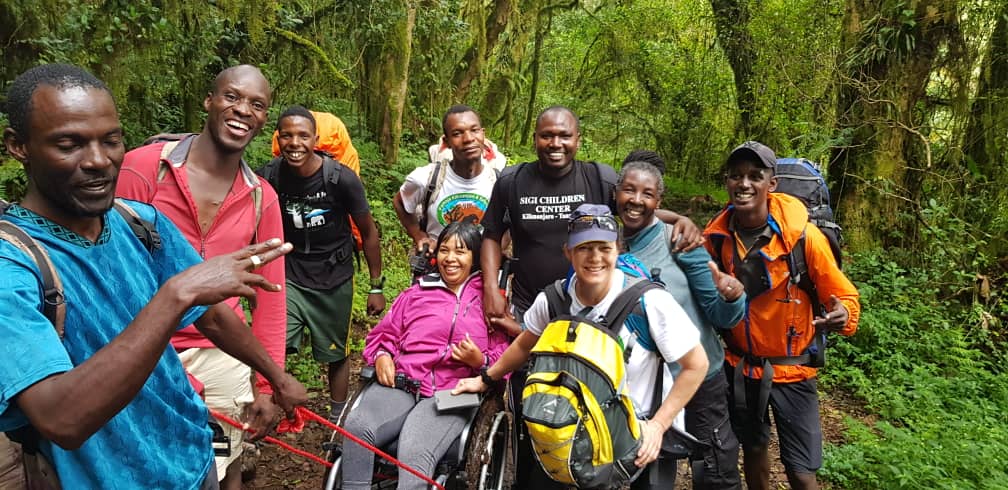
The actual trek begins at a gate that opens into the mountain. We sign the climbers’ book of consent and jump about to test our climbing boots and our mountain muscles.
We take a few pictures and wish each other good luck. Ann from Kenya says to us, now it is you and your legs. See you on the mountain. She saunters off. She has the energy of an antelope.
We are a bit worried as we set off. Clearly Ann is at another lever as a climber. But we are already in the no surrender zone. Fortunately, the gentle slope tricks us. It feels so soothing. We chat as we walk. We sweat as the mid-morning sun hits out backs. The mountain plants are a wunderkind sight!
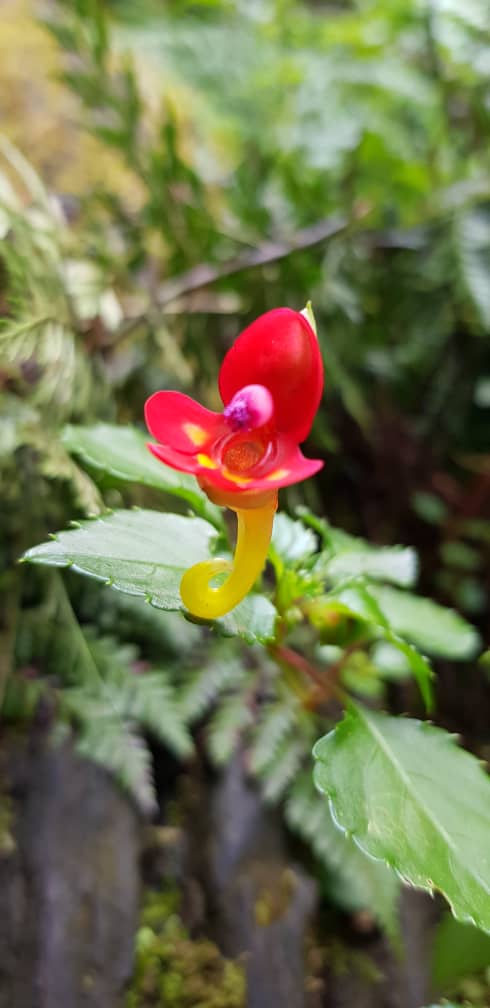
Giant trees stand at attention. Some have been here for hundreds of years. Small leafy trees take their space too. Little plants with flowers that literary light up the bushes are also present. For several kilometres the path moves along a whizzing stream. It feels like the stream is watching over the trekkers and keeping them company. When its sound starts to become distant, we start to worry; like we are losing one who has been a steadfast companion all along the journey.
We reach Mandara, the first camp on our route, at about 5.00 pm; a long first day. We are tired but we are excited. This is not our first trek though. A few years back we (Hilda, Pam, Sam), had climbed Mr. Muhabura in Western Uganda and Mt Elgon in Eastern Uganda. The Tororo Rock too in Tororo! In comparison, Mt Kirimanjaro is a friendlier slope so far. We do not want to remember the Killer Muhabura. We take our evening tea and chat away the evening as we wait for dinner. We are served at about 7.30. Everybody is scampering for hot soup! Thank God it is more than enough! The disappointment is that after it gets served by the time it reaches the lips it is no longer hot! The intense cold has already dealt with it. We go to sleep at about 9pm after instructions to be up by 7am so that we set off by 8. But do we sleep? The cold! It is that type of cold which sneaks to your every part of the body including the hair.
The second day starts on a very positive note. We remind each other about our cause for the climb; to save a life and put a smile on faces of a few children who will receive the life jackets. It is a pleasant day after all.
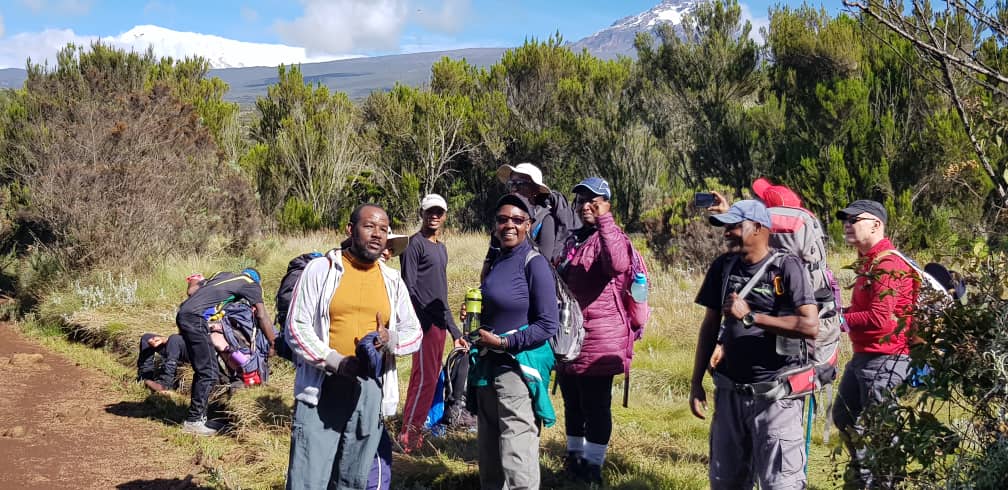
Some light rain and light sunshine accompany us. Jacob and Fred; the awesome assistant guides, explain to us that rain is good for mountain climbing because it helps to improve oxygen levels. As we go higher the terrain is changing too, to steeper slopes and shorter trees and shrubs. There is plenty of grasslands too, like a wide green carpet stretching on the slopes of the mountain. The mountain flowers are different too. The small red and pink ones downhill give way to small purple and white ones. By the time we seat and lie on smoothly curved rocks to eat lunch, we are almost finished. Our energy level is almost flat curve. But thank God, the lunch pack handed to us is some sort of recovery plan.
Very interestingly, along the way we reconnect with our whizzing stream and we are excited to find out that our next camp; Horombo, is positioned close to the stream. We do not see the stream but we hear it. When we eventually go to bed, it sings us to some sort of sleep, stealing itself in-between slabs of cold.
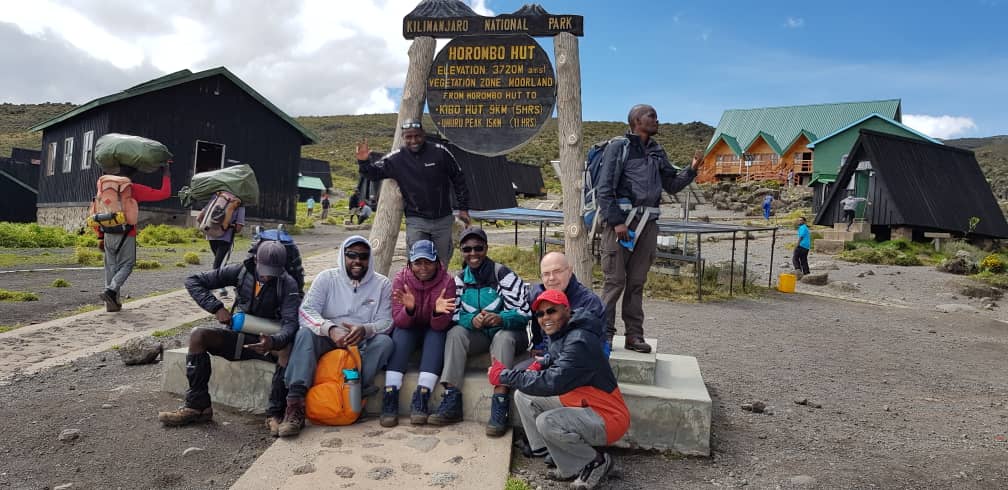
When we set off on the third day, we remind each other about our mantra for the journey; Things always fall into place – if we let them. The mountain is becoming steeper and colder. The vegetation is getting scanty. We are getting tired. But we are a strong team.
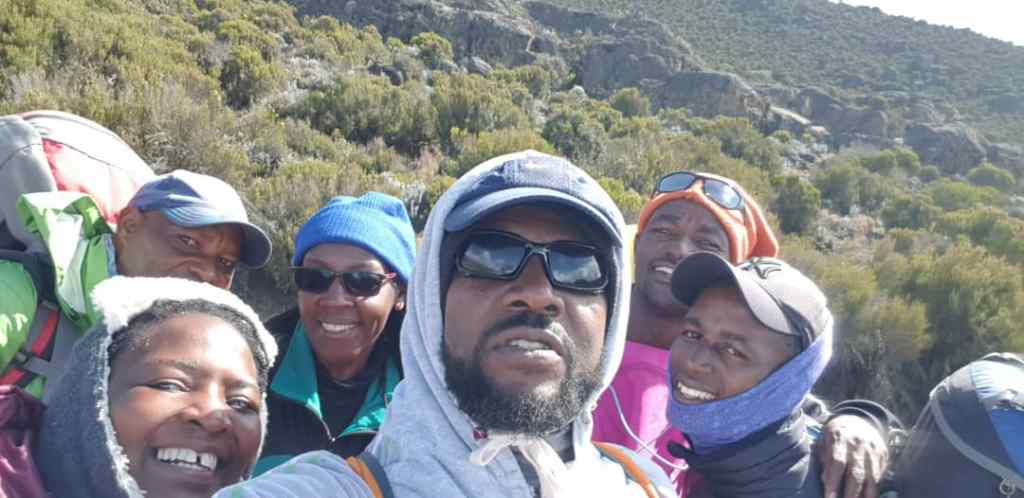
We head away from our great companion; the mountain stream. It is an extremely long day. When we stop to eat our lunch; a few biscuits, a piece of chicken, an egg, a banana and a small juice, we just want to remain seated. But we must move on. Sam is on a chicken fast so Pam and I share his piece. I give him dry fruits in return; pineapple. Jacob laughs and tells us we must eat a lot of food but he does not explain why. We need the food man! We are not just hungry. We need the energy!
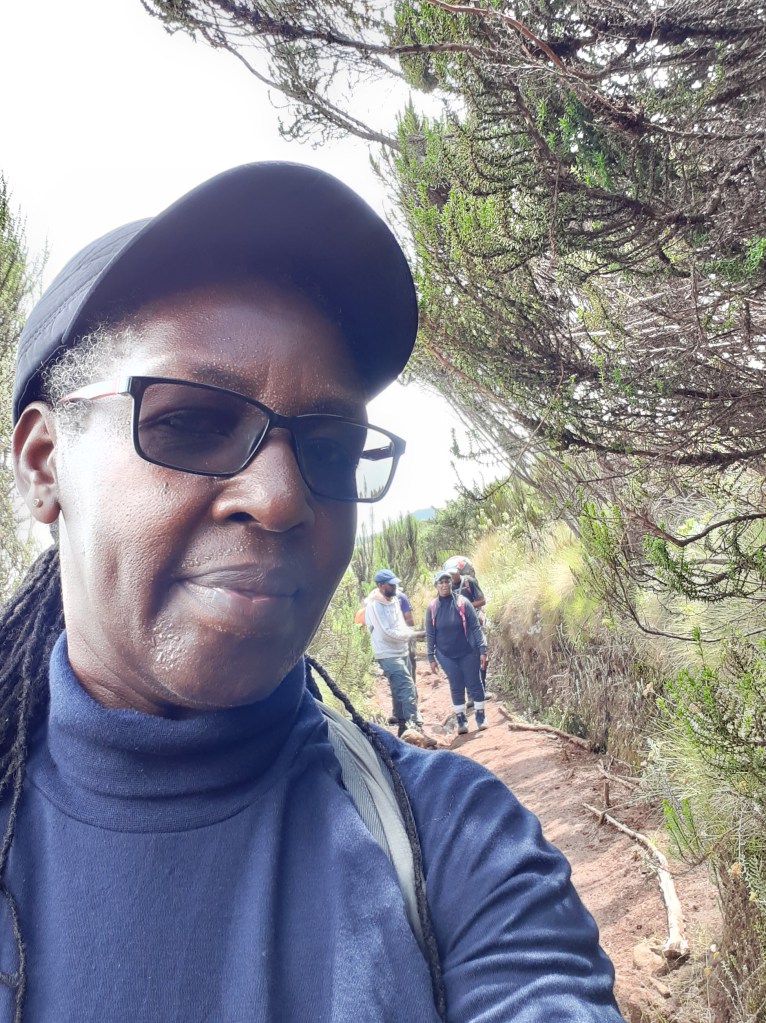
As we approach the 3rd camp it looks like it is set right under rocks and white glaciers. But as we get closer, the camp looks more spacious and not so under the rocks. The glaciers slither through the rocks away from the multi-coloured camp huts. The signpost welcomes us. Kibo Camp.
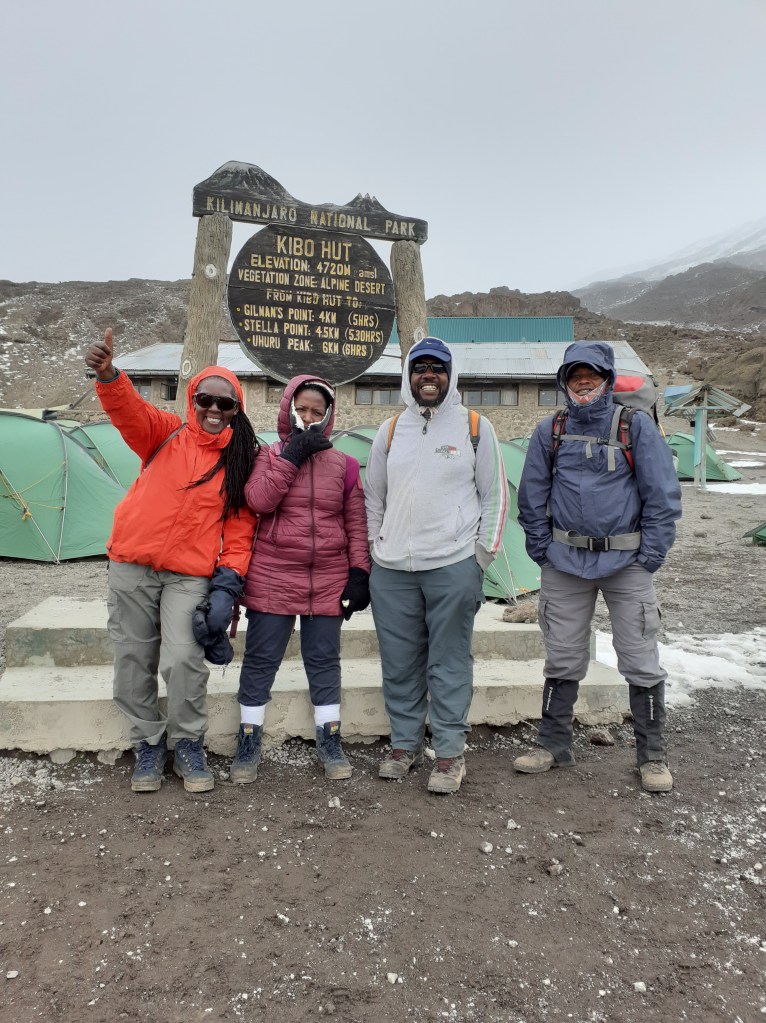
Kibo is very interesting. It is like a proper homestead. A few huts close to each other, a few tents for those who do not want to use huts, people cooking, and people talking. And who says East Africa does not know snow? In the early evening as we prepare to go to bed, a few snowflakes begin to do their dance in the air exciting some of us. By now mountain climbers are quite many. Maybe we are about 30 people at Kibo Camp. Later, more snow comes dampening our spirits. We all quietly pray that it does not go on. We watch it gather and build in front of our hut doors. We refuse to imagine coming all the way only to end at Kibo due to snow!
By now David has convinced us we are strong enough to make it to the top of Mount Kilimanjaro – The roof of Africa – and back to Marangu gate in five days and he has shared the plan with us. We are hesitant. The plan involves sleeping half way through the third night so that we wake up in the night and start the final climb at midnight as the fourth day is just starting so that we summit at Sunrise and return to Kibo by mid-morning.
We are trapped! Sunrise on top of Kirimanjaro would be the most amazing experience any climber could hope for! David adds that that plan would allow us to get back to Kibo during the day after summiting, rest a bit and set off late afternoon back to Horombo. We would then sleep at Horombo on our way down. Five Days!
We are all excited and we swallow David’s bait. We eat our dinner quite early between 5 and 6pm. We are advised to eat little because oxygen is dwindling and therefore not enough for breathing and doing the heavy job of processing too much unnecessary food. We now understand Fred’s laughter. Kibo is at 4,720 Metres elevation above sea level.
In the end we do not really sleep half the night because we are up by 10pm. Some of us have not even slept at all. If the cold at Mandara and Horomo could fill buckets, the cold at Kibo sticks to the body like a tick. It cannot be shaken off whatsoever!
We eat our “breakfast” in silence. David checks our clothes, our raincoats, our water bottles, our neck scarves, gloves, and windbreakers. Some of us do not have some of the essential things. Those who have anything they can spare pass it over to the person in need. Jackets, gloves, scarves, thermos-vests and huts, exchange hands. Things indeed fall into place! I also benefit from the exchange. Ann, remember Ann from Kenya, passes a nice little pink jacket. I hug it to my body like I have never owned any jacket before. David from Kenya passes green gloves. I slip them on immediately over my other pair. I pull out a raincoat too and pass it over to Pam because hers is too light.
We are all praying that we make it. The snow which has gathered on our doorstep as we set off is scary. But we move nevertheless. We have an agenda. We need to accomplish our race, raise funds to buy Jackets for school-going children.
Walking in the middle of night, through rocks, through knee-deep snow, though chunks of cold being hurled into your face turns out more adventurous than we had signed up for! It is clear we are being accosted by a blizzard and it intensifies with every step. We walk on. Fortunately or unfortunately for us our Chief Guide, David, gets caught up. One of his clients gets a problem and he stays behind to help. We are on our own with three of his most trusted assistant guides. We meet some people returning and they tell us we cannot summit. Why, we ask. They tell us the summit area is almost cut off by the blizzard. We listen but we continue. One laboured step after the other. One laboured step after the other. We think we should go back. It is becoming really dangerous. But the thrill is too tempting too. We can already see the rock above which is the end of the climb!
We stop briefly to agree to return. Instead we agree to move on. It should not take too long. We are almost in tears! And then, one by one we climb over the rocks and we are in the summit area! We are so excited to see the signpost! Congratulations! You are at Gilmans point. We have summited! We take a few snaps and the phones freeze!

We must take a picture in the Lions Jacket! One of us screams. But none of the phones can turn on now. They are frozen. We had hidden them deep into our pockets wrapped in layers of things to keep them warm. But have already exposed them enough with the few pictures we have taken. As we bargain on what to do, stronger than any wind we have ever witnessed hurls us against rocks and against each other. We can hardly look up! Bellow the other side of the climb is an escarpment. In the circumstances, we feel like we are at the edge and the wind could easily blow us downhill. We must return now! Jacob says. This time we do not question him.
That we write this story is testimony that we returned safely. And had we taken a few more days enjoying Arusha, COVID-19 Lockdown would have found us out there.
Whereas over one hundred people had pledged to support, COVID happened and the story took a totally different turn. For most of our economies, where most of us are never sure of our next meal, COVID became a monster. But we thank God for a safe journey and for every coin that was raised.
A big Thank you to Team – Things will fall into place, if you let them! A bigger thank you to all who contributed to the climb as listed below! I am all GRATITUDE on behalf of my home area, Lake Bunyonyi region!Together we brought a smile to the faces of the children.
Kilimanjaro Climb for Life Jackets
- Hilda Twongyeirwe and Family 300,000
- Pamela Batenga 120,000
- Samuel Iga Zinunula & Patricia Nyachwo Zinunula 270,000
- Stella Nanziri 320,000
- Sarah Mukasa 200,000
- Bwesigye Bwa Mwesigire 260,000
- Chris Conte 300,000
- Brian Nadhomi 50,000
- Kimberly Poole (International Sheroes Union) 120,000
- Mary Mahoro 120,000
- Warda Katende 60,000
- Mary Jo Kakinda 65,000
- Oscar Ranzo 50,000
- Kakuru Karemeera 325,000
- Doreen Straus and Family 490,000
- Ahimbisibwe Joab Kahangura 50,000
- Edna Kahangura Natweta 50,000
- Frank Kwarikunda 50,000
Total Amount Raised on the mountain 3,210,000
Keep your ear to the ground and join The Overwhemers for the next climb for a cause!
For Health & Resourcefulness
GMT Networks in Uganda: Keeping on the Move
A lot is cooking for GMT Networks – Uganda. August has been a busy month as the team planned for the coming High Level Roundtable Convening to be held on 8th September at the Imperial Royale Hotel in Kampala. The Roundtable is part of the Graca Machel Trust Women’s Leadership for Financial inclusion and Economic Recovery Initiative (WLFI), which is being implemented by different GMT affiliates across the continent.
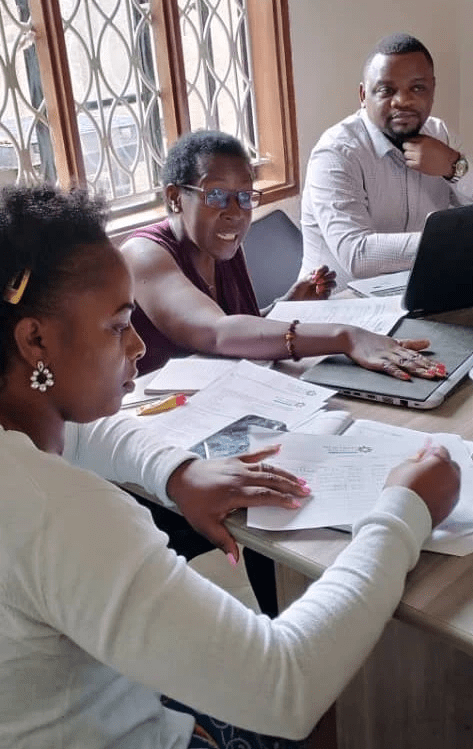
The Roundtable is aimed at seeking commitments and political will of relevant policy maker and leaders, to the recently launched Gender mainstreaming standards for Gender inclusive Covid-19 Economic recovery interventions. The launch, which was followed by a convening of the National and Regional female representatives on the task force for covid 19 held at Hotel Africana in July set the pace for the three-year project. Participation in the Roundtable discussions is open as it is a hybrid of online and physical. It is going to be an interesting conversation for all those interested in understanding politics of inclusion and exclusion as shaped by policies and and policymakers. Many times there is lack of spaces for the public to join conversations towards policy change or shaping new policies. This is an opportunity to Join the the conversation and be part of teams seeking to influencing Covid-19 economic recovery strategies in Uganda, starting at 07:00 AM. Zoom link is; https://us02web.zoom.us/j/86346915876?pwd=aXRNZURtcVhNYmxCR2RoUlg2UzRoQT09, Meeting ID: 863 4691 5876, Passcode: 848637.
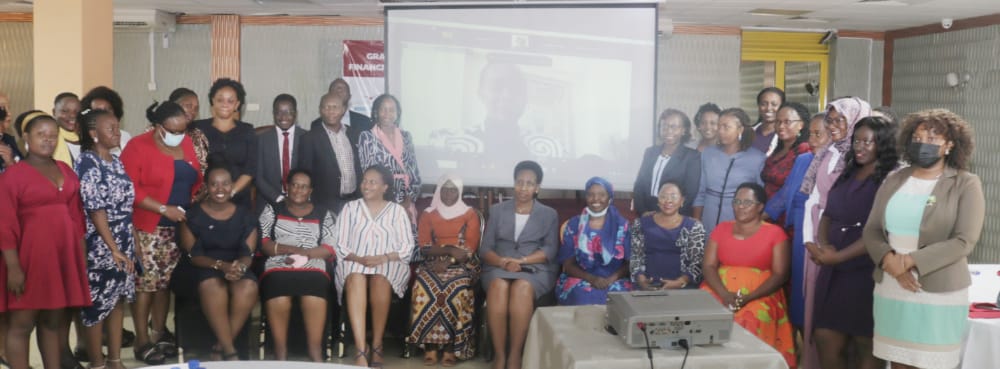
Network members have been busy following up on the different outcomes of the WLFI activities while at the same time driving other crucial activities in individual networks relevant to GMT strategies. The National Association of Business Women (NABW), was the lead convener of the 3rd COMESA Federation of Women in Business, held at the Uganda Museum and Sheraton Hotel in Kampala. Through the generous support of Graca Machel Trust in South Africa, all GMT Networks in Uganda were represented at the event. In her speech, NABW Chairperson Florence Kasule recognised the important role played by GMT to drive business opportunities for women in Africa. The Minister of State for Trade, Industry and Cooperative Hon. Ntabazi Harriet notably promised to help women advance their agendas to bring them the money needed to improve their businesses when they submit their proposals and budgets.
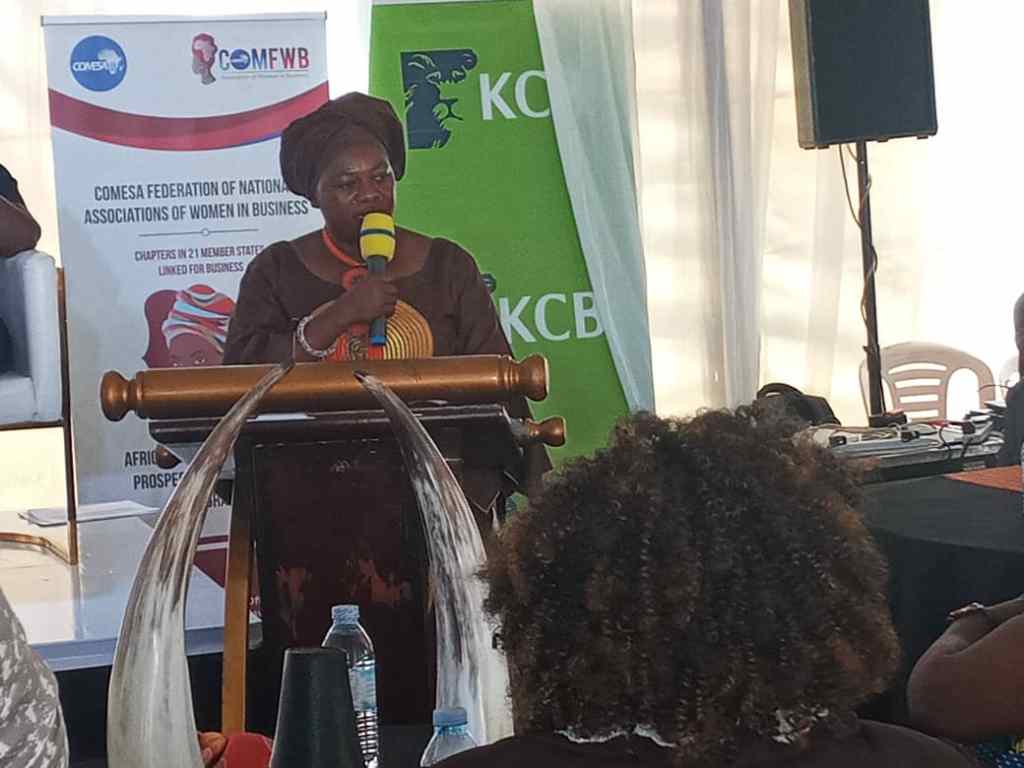
The theme for 2022 was; ‘Business Women Advancing Regional Trade.’ The emphasis was on the need for the recognition of the contribution of business women to economic development in the region. The team pledged to continue to be in line with Agenda 2063 goal of transformed economies with a focus on economic diversification and resilience.
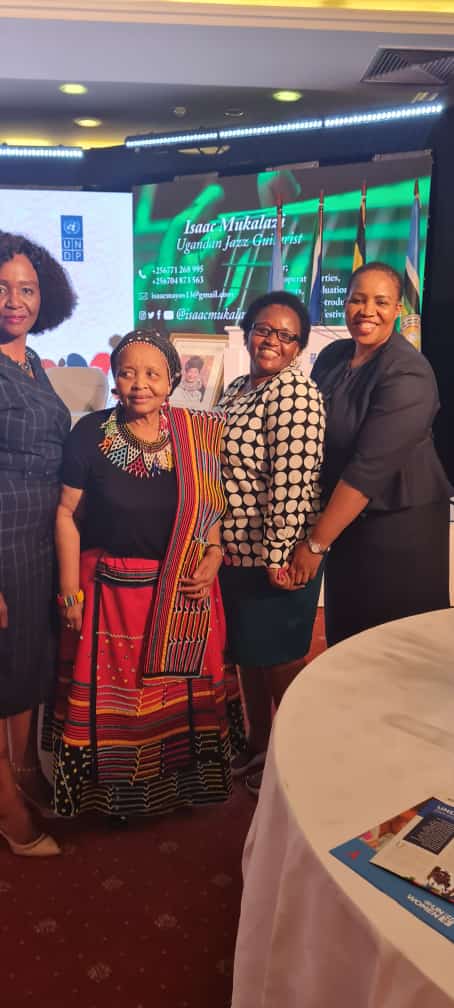
In other developments, Theopista Sekitto represented GMT networks at the South Africa ‘s Women’s Day Celebration 2022 at Serena Hotel in Kampala. The South African Ambassador to Uganda recognised GMT Uganda networks for the post-covid economic recovery and financial inclusion initiatives targeting women.
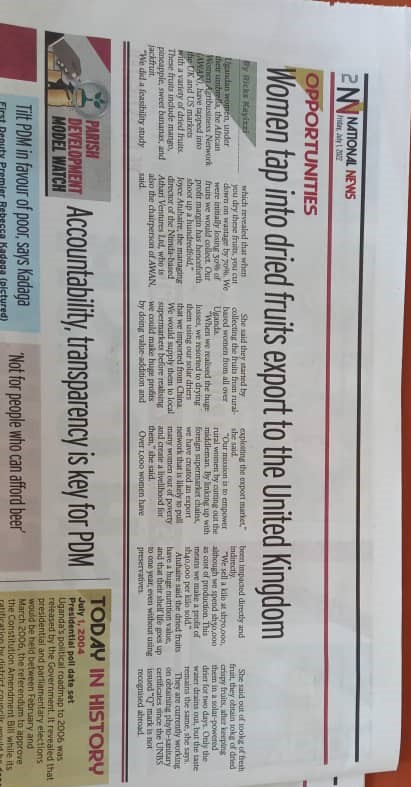
To celebrate the season AWAN, led by Joyce Atuhaire, held the candle high when their team won a grant to enable them trade opportunities in dried fruit in the UK.
GMT – Uganda Networks convenes a National dialogue on Female representation on Covid 19 response and Economic Recovery task forces in Uganda
When Covid 19 hit in 2020, all nations were literary forced onto their knees due to the unprecedented challenges it came with. Within only a few weeks and months into the pandemic, all sectors of the economy struggled to operate, leading to a global economic crisis. As a result, almost all governments constituted Covid-19 response task forces to manage the crisis. In Uganda, the government constituted task forces, under disaster management framework, at national, sectoral, district and local levels. The task forces were involved in case management, surveillance, health promotion, resource mobilisation, enforcement of SOPS at all levels and now economic recovery. It has been noted that in Uganda, women were at the helm of the first National Task Force, notably; Hon Mary Karooro Okurut who was then a Minister in Charge of General Duties in the Prime Minister’s Office and Dr. Ruth Jane Aceng, the Minister of Health.
The Graca Machel Trust – Uganda Networks, spearheaded by the Network of African Business Women – Uganda Chapter (NABW-U), on 29th June 2022, held a convening of Women Representatives on Covid-19 response and Economic Recovery task forces. The event was held at Hotel Africana in Kampala and was presided over by Dr. Pamela Mbabazi who represented Hon. Mary Karooro Okurut, the pioneer lead of the first Covid 19 National task force. Dr. Mbabazi is the Chairperson of the National Planning Authority, a key institution in shaping national development strategies.
To organise the event, NABW-U worked with other Uganda chapters; New Faces New Voices (NFNV), Africa Women Agribusiness Network (AWAN), and Women in Media Network (WIMN), who are the implementing partners for the GMT Women’s Leadership for Financial Inclusion and Economic Recovery (WLFI) Project that is supported by Bill & Melinda Gates Foundation (BMGF).
In her speech, the guest of Honour underscored the key role the women of Uganda have played in the management of Covid 19 health Crisis. She thanked the government of Uganda for trusting women to deliver on task forces.
It is worth noting however, that although women have been a major workforce in COVID-19 response making up to 70% of healthcare frontline workers, they have been extremely underrepresented in government task forces. For instance, a review of 225 COVID-19 task forces from 137 countries by UN Women established that women representation was only at 24%. According to Ms. Florence Kasule, the Chairperson of NABW, “this underrepresentation negatively affects women’s recovery from the adverse impact of COVID-19 because without women in decision-making positions, there is a high risk of ignoring women’s needs in the Covid-19 response and recovery measures taken by governments.” The 1995 Constitution of the Republic of Uganda, article 10, guarantees gender equality. Article 180 of the constitution stipulates that one third of the membership of local government shall be women. Considering that task forces are part of local government establishment, it is important that the question of gender balance is articulated at formation of these TFs. To this, Ms. Kasule stated the demand for 40% women representation at all task forces at all levels.
According to the project lead researcher in the qualitative study, Ms. Kirabo Subi, there is inadequate data concerning women’s representation on Covid 19 task forces. Ms. Suubi further explained that in her findings, “women were more hit by the pandemic because most of the sectors where women operate were closed while those dominated by men such as bodaboda, construction, etc. remained open. It was majorly market women who stayed at work to provide food to the community at the risk of their lives and their families.” Women’s situation was worsened by the immobility challenges. When for instance men rode bicycles to move around and forge a way forward, women stayed home. In Uganda, it is only a handful of women who own or can even ride a bicycle.
Another highlight of the event was the keynote address by the President of the Uganda Law Society, Ms. Pheona Wall, in which she challenged women to support one another to excellence. “Be the woman that breaks the glass ceiling for other women to excel,” she said. She brought a silent chill into the room when she said that most women are just one sickness away from poverty and bankruptcy. She encouraged women to invest more, have lawyers and even consider insurance. “These contracts you sign are prepared by lawyers. You need lawyers to interpret them for you before you sign them.” All the women in the room looked at one another as they digested the reality of their economic situations.
The keynote was followed by a very animated panel discussion where many issues were brought up both from the panel and the audience. Panelists included: Ms. Amina Lukanga (Kampala Resident City Commissioner – RCC), Mr. Allan Ssenyondwa (Private Sector Foundation), Ms. Violet Kabasindi (Informal Sector workers representative in Kampala, Wakiso and Busia,) Juliet Bagaaya (Centenary Bank) and Hope Katwiire (Kampala City Traders Association – KACITA – Women’s League).
Ms. Hope Katwiine proposed that Recovery Task forces’ composition should have women from the women’s groups and not just those in political appointments. The Kampala Resident City Commissioner (RCC) Ms. Amina Lukanga said that sometimes she has had to step away from Government side to the women petty traders’ side because she understands the economic challenges they are faced with. “When we raid streets and take a basket of mangoes, sometimes that is all that the woman possesses. It is her capital. It is her income. It is her everything,” she said. She pledged to support the 40% women representation proposal to ensure meaningful economic recovery. Mr. Michael Kitamirike from Ndejje University emphasised the need for government to explain to Ugandans what they are doing to address the post Covid era. Ms. Beatrice Bbale Nakayiki from President’s Office said, “Economic recovery programmes will remain jargon unless the country shifts the discussion to production and productivity.” But maybe there is need for government to also shift from handouts in form of development models. Looking for instance at the 100 million shillings in the parish development model, it is important that proper monitoring is done and real impact is studied and documented so that it does not become like the past models which have failed miserably keeping many Ugandans in poverty yet money is spent.
The networks plan to hold training activities where women representatives on task forces will be trained in lobbying and advocacy skills and other skills that will make them more effective and accountable to the nation and to the women who they represent.
The event was graced by the Graca Machel Trust Director of Programmes, Ms. Shiphra Chisha. In her remarks, she emphasised the commitment of GMT in improving lives of African women and children through their 3 main programme areas; Women’s Economic and Social Advancement, Children’s Rights and Education.
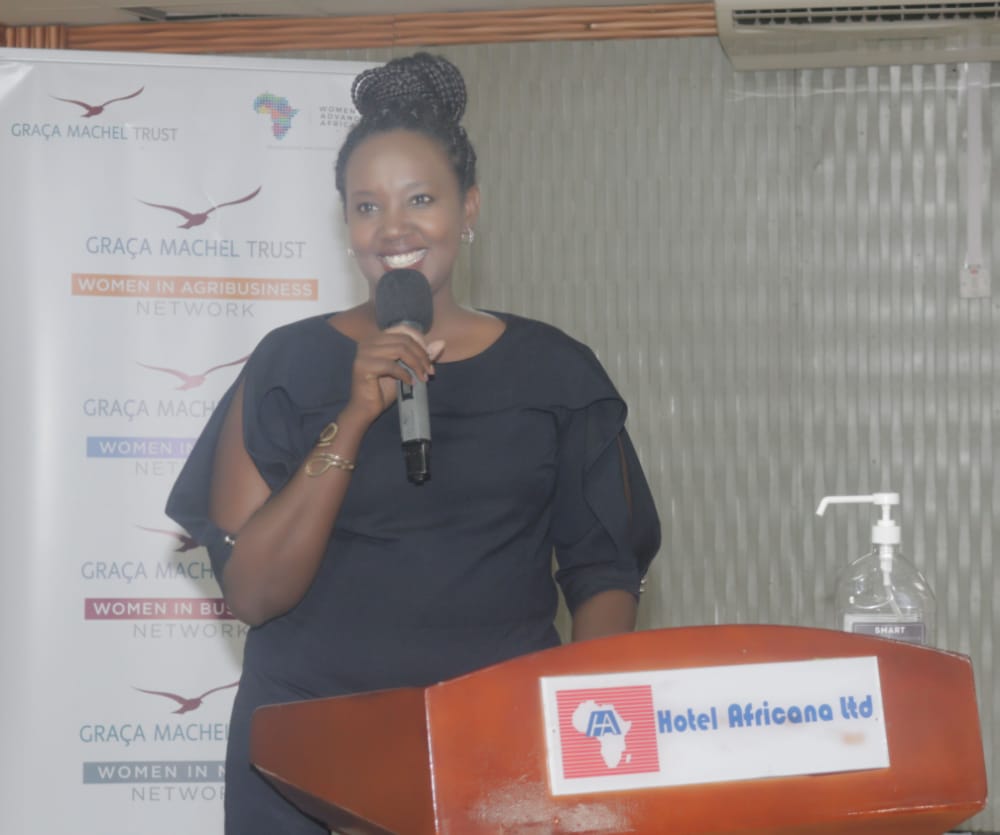
Photo credits; Native TV International
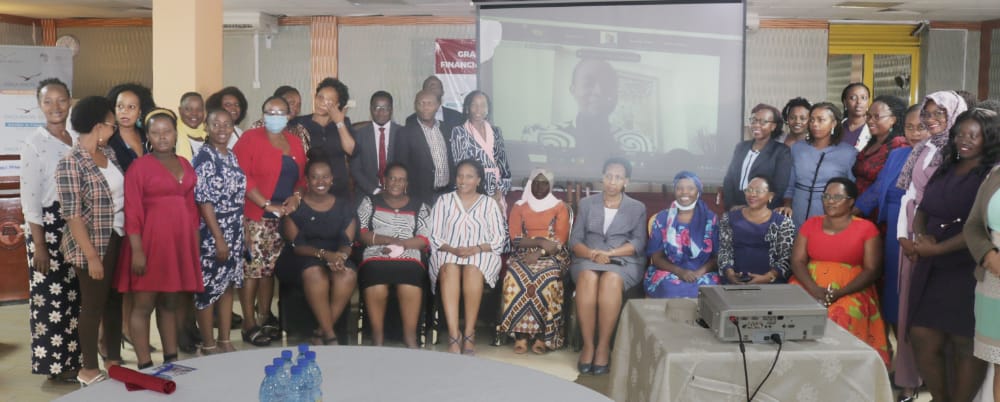
Photo Credits; Native TV International
The Author, Hilda J. Twongyeirwe is a Member of FEMRITE – Uganda, The Lions Club of Kampala Central, Action for Development, The GMT Women in Media Network and The Pan African Writers Association.
 Twongye'wanderings